

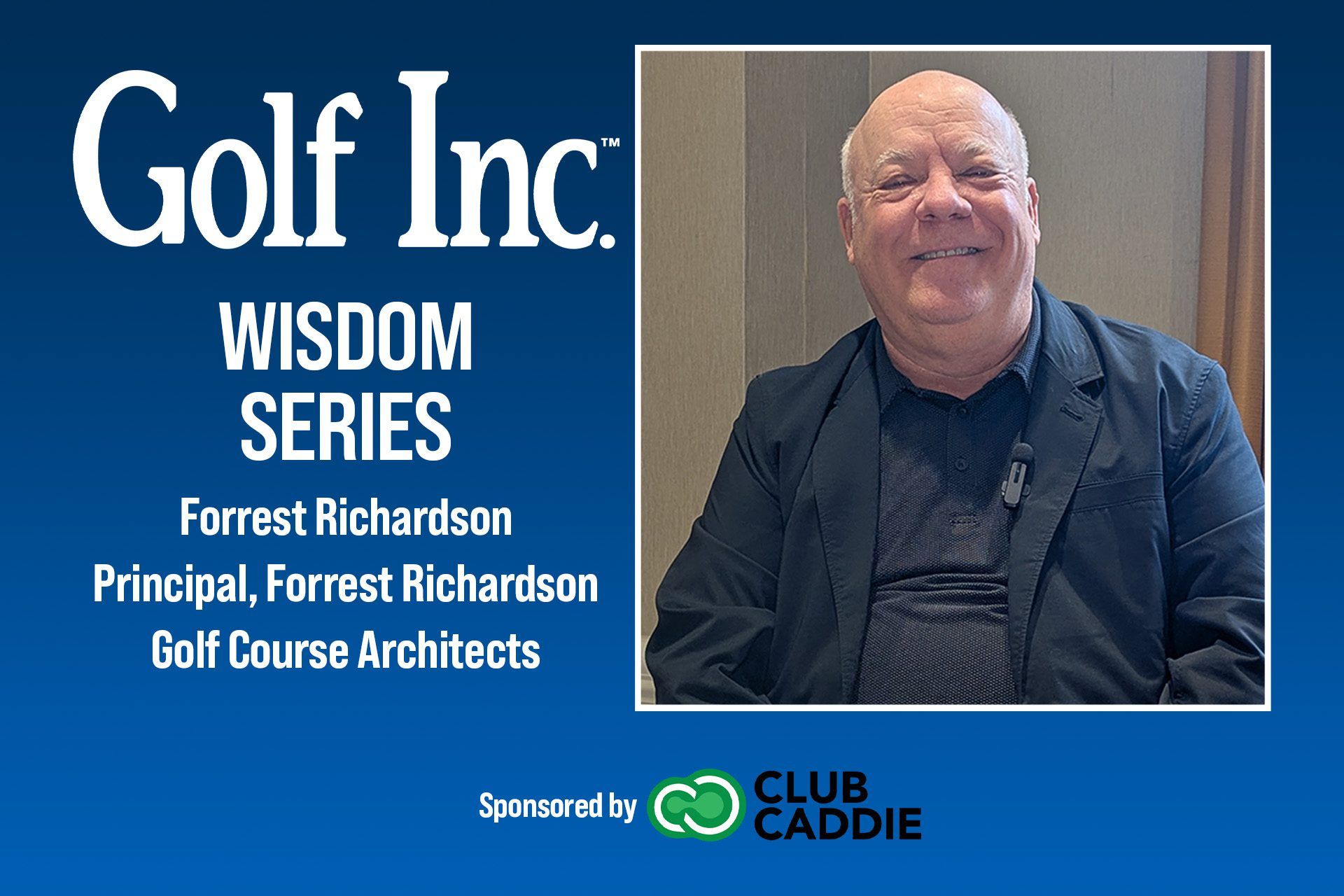
We sat down with Forrest Richardson, principal at Forrest Richardson Golf Course Architects, at the Golf Inc. Summit in September and got some insight into the mind of a golf course architect. He told us about the principles guiding his design approach, the rise of short courses, the role technology has in determining design choices and more.
Full transcript below (lightly edited for clarity):
What core principles guide your approach to designing or renovating a golf course?
I think in today’s climate of golf course design, renovations are, of course, the mainstay of what we do. And every project and renovation is different because every golf course is different. The key is really identifying what the goals and objectives are, how you’re going to get the ROI on the project and the investment. And one of the things we always focus on is “what’s the warranted investment,” which is something I think that a lot of times people just throw around renovation, restoration, re-imagination, all the R words. And they don’t sometimes focus on understanding the goals, the objectives and getting to that number that really starts to set everything in motion. Because we can design, as architects, anything imaginable, obviously, but it doesn’t always pencil. So I think that’s the real fundamental key in renovation and remodeling, all the R words, is understanding really what the limits are to make it financially appropriate.
How do you see the rise of short courses, par-3s, and non-traditional formats shaping the future of the game?
We’re really talking about a pastime, a game, a way of life. And the tangents are just amazing, as we all know. There’s fashion, there’s real estate, there’s travel, there’s hospitality. And it all comes back to the game, the playing board. That’s where the architects come in. And what’s happened in golf is that there’s been a tremendous shift in the consumer to not necessarily being interested in a standardized format for the game.
But what we’re seeing today is a resurgence in alternative formats, non-course formats. And really what it boils down to is anytime the people in the business of golf can put a club in someone’s hand, we win; everyone wins. So, miniature golf, simulators, short formats of golf, loops of holes, practice ranges — anytime we can put a club in someone’s hand, we win. What’s happening in golf architecture is we’re no longer thinking necessarily of 18 holes, par 72, 4-1/2 hour durations of playing the game. Short courses, as everyone knows, are off the charts with interest. People want to have fun. The Z generation, the Millennials, they’re more about having fun, socializing. And so all of these things are coming together in a great big tsunami of architects being asked to push the envelope and create formats that are putting only or short game only or less than 18 holes. There’s all sorts of different formats for golf. Some haven’t even been thought of yet. And I think that combined with the architecture and the management is really the future of the game, is really pushing that envelope.
How do you view technology—both in terms of construction and in how golfers interact with the game—shaping design choices?
The first project that I worked on where I built a golf course using satellite navigation, which was integrated to the construction equipment, was in 2007. And it was very, very early in the development of that technology. Today, if we can imagine a golf course and get it from up here [taps side of head] into a set of plans that’s accurate, we literally can build the golf course robotically with construction equipment and moving dirt and sculpting the land. Now, that doesn’t mean that the golf architect has any less say about it, because you have to keep in mind, you have to get it from here into a set of plans in order to instruct those robots what to do. So I think from the perspective of technology in golf design, that’s the most dramatic. I’m not saying it’s the right way to do it, but there’s now an ability to literally create something in one’s mind with the client and the ownership, get it to fit the land, and the building of the golf course can be much more robotic. So both in the building and the maintaining of a golf course, the architecture part of the whole world of golf business is really thinking about how we make those things happen so that our owners can be more efficient when they take care of a golf course with all the new technology coming out. It’s very exciting.
What are some design features that today’s golfers are responding most positively to?
The definition of today’s golfer is the most diverse I’ve ever seen. The collection of golfers we have is very, very diverse compared to what it was in the 1960s and the 80s. What are they looking for? I think the common denominator is they want to have fun. They don’t always buy into the notion that it’s an all-day event. They also want to be comfortable. They don’t want to be forced into the regiment of the old school of golf. Now, that doesn’t mean the traditional values are thrown away. What it means is we have to blend those things and reach a happy medium between the really, really cool kind of legacy club that has a certain feel and spirit to it, but also be comfortable, fun. And then one thing that — this is my opinion — scoring success, golfers always like. Okay, so if we just punish the golfer as architects and make the course difficult and hard and a real regiment to get through and they don’t score well, the chances are the memory isn’t very good. But I really believe that the recreational golfer, the 99.5% of all golfers in the world, they want to leave the course feeling good, scoring success. That doesn’t mean the course is easy. It just means that every so often they’re rewarded by having some really, really amazing thing happen, whether it’s a birdie or a putt for an eagle or a chip for an eagle or close to a hole-in-one or whatever. Again, it’s not making the course easy. It’s just making the course conducive to scoring success. And I think even though golfers might not articulate that, that’s something I’ve learned over the years. If the golfer can have the ability to come away with success, you’re probably going to have a repeat customer that loves the golf course, thinks that they’ve figured it out, wants to share it with other people and say, “Hey, I know how to play this hole, I’ve figured this out.” That’s really the key to me of what the golfer is looking for.
How has sustainability influenced your work in recent years?
There are lots and lots of moving parts to the environmental sustainability of golf. The problem with that, apart from the financial and the recreation and social sustainability — the three stools of sustainability — is that the environmental one is the most complicated for the average person to really understand. And golf gets bashed all the time for the environment. However, when you really look at it, all of the arguments, if you will, of golf using too much water or using too much land — golf courses in the United States account for less than 4% of that total lawn area in the United States. It’s cooling the environment. It’s borrowing water. It is using water, but it’s borrowing a good portion of the water. Most of that water flows into drainage channels, and very often it goes through or to a golf course. where all the billions and billions of little blades of grass filter out those pollutants, and then the water goes back where it came from. Sustainability in golf architecture is really the core, I would say, goal of golf course architecture. We want to create something that has social and recreation value. That’s obvious, that’s the playing board of the game. And the perceptions and the realities are very different. So as golf architects, when we look at the sustainability of our work, it’s easy to answer the easier parts of it. The environmental one is very difficult, but I can say that we’ve made tremendous inroads to use less of everything on a golf course: less land, less water, less fertilization. We really, really have made inroads in that, and we’re continuing to do it.