

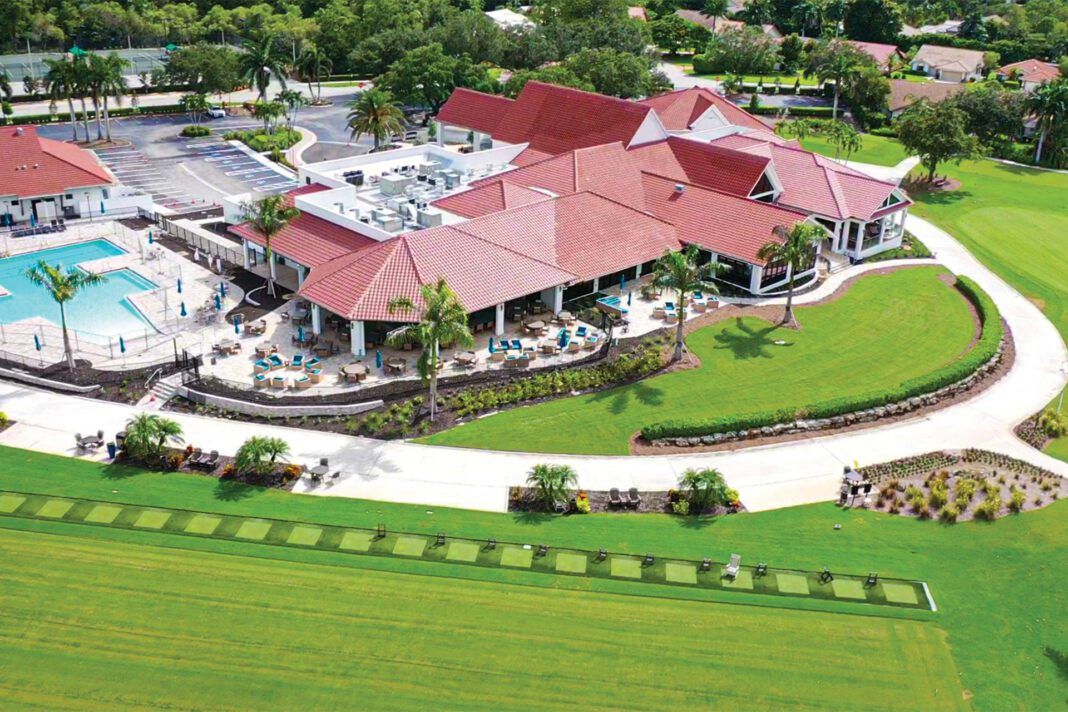
The surge of new golfers, combined with changing expectations among existing players, is pushing clubs to rethink how they use their most important asset: the clubhouse.
Long viewed as a central gathering space, today’s clubhouse is increasingly being evaluated as a business asset. Owners and operators are looking beyond aesthetics to how space can generate revenue, improve the guest experience and keep members on property longer.
Clubhouses have traditionally been designed to convey stability and permanence, housing key profit centers such as the pro shop and food and beverage operations. But today’s golfer is placing greater value on convenience, flexibility and a more welcoming environment for both regular patrons and first-time visitors.
That shift is influencing where clubs are investing.
F&B drives consistent revenue
Food and beverage remains the most consistent and scalable revenue driver within the clubhouse.
According to GolfNow for Business, up to 66% of golfers spend money on food and beverage during a visit.
Consultants at Entegra note that expanding dining and hospitality offerings is a core strategy for increasing revenue.
Club Benchmarking data shows food and beverage accounts for roughly 30% of operating revenue at the average private club, with similar ranges reflected in income per member. While margins may be lower than golf operations, the majority of clubs subsidize their F&B offerings, reinforcing its role as a driver of engagement, utilization and overall spending rather than a standalone profit center.
This evolving approach to F&B is part of a broader shift in how operators think about clubhouse space.
Skip Avery, a veteran of the club industry and 2012 CMAA president, now serves as director of club development and principal at Stone Group Architects.
“When you start thinking about features that produce that ROI, I always say it doesn’t really matter whether you build anything if you’re not going to program that thing to be successful,” Avery said. “So whatever amenities people spend money on, they want to make sure that they’re setting the right tone, and that they have an idea of how they’re going to service it, how they’re going to run programs through it.”
Avery said owners of facilities have to understand what they’re in competition for: their customer, their member and their customer’s time.
“Whatever you can do to make their time better at your facility, the more you make them feel comfortable, the more they’re going to stay and spend money,” he said. “Again, it’s making sure that you have the right kind of program, that you’re offering the right services and that you can produce a real positive experience, so people want to use that over and over again.”

Designing for the changing member expectations
A clear example can be found at Countryside Golf and Country Club in Naples, Florida.
Joe Smith, general manager, led a 10-year strategic plan that addressed nearly every profit center, including the clubhouse. When he joined, the membership had just approved a $5.5 million golf course renovation, and he guided the club through that process before turning to the clubhouse.
“The building was 40 years old and the desires of the membership were starting to shift, but also the market was changing, with a real shift in what was going on outside of our gates,” he said.
Smith recognized the importance of aligning improvements with evolving member expectations.
“Down in this area 20-plus years ago, everything was golf centric,” he said. “We’ve got an 18-hole golf course where we do about 45,000 rounds a year, so it’s a busy, busy club.”
Over time, however, priorities began to shift.
“Our members are thinking, ‘I want to play two or three times a week, but what else is available to me?’ And that’s where these other elements start to come in: wellness and fitness, outdoor dining, pickleball, tennis, bocce, more casual style dining and practice facilities. It’s really about the overall package versus just so golf centric,” Smith said.
In response, Countryside expanded its clubhouse and dining operations, significantly increasing capacity and variety. The club now offers multiple dining venues, including a grill room with an outdoor terrace, a main dining room and an outdoor resort-style pool café, a concept that did not previously exist at the club.
“That was, ironically, the biggest item that members pushed back on, but without question, it’s the most popular thing we have now,” Smith said.
Practice facilities as profit centers
Practice facilities are also gaining attention as potential revenue drivers.
The growth of off-course golf is reshaping how operators view practice facilities. Data from the National Golf Foundation shows that participation in off-course formats, including driving ranges and entertainment venues, now rivals traditional on-course play. Venues such as Topgolf have demonstrated the revenue potential of more social and technology-driven practice environments, particularly among newer and younger players.
Chris Smith, vice president of marketing for Power Tee, said the system offers convenience for customers, but the impact for operators is significant.
“Diving ranges or golf facilities with ranges increased revenue by anywhere from 20% to 40%,” he said. “It’s definitely a benefit for the golfer, but from the golf facility perspective it speeds up the golfer. They hit more balls, they enjoy the game and ultimately generate more revenue for the golf facility itself.”
Charles Raulerson purchased Fleming Island Golf Club in April 2013 and has since transformed it into one of northeast Florida’s top golf destinations.
The highly rated public course, designed by local architect Bobby Weed, features a diverse 18-hole layout and modern amenities that appeal to both serious golfers and casual players.
In 2021, Raulerson introduced 12 Power Tee automatic teeing systems at the club’s Top of the Tee driving range. Since then, range revenue has increased by 25% to 30%, while participation is up 20%.
“Our members and guests have really enjoyed the addition,” Raulerson said. “They’re hitting more balls. They’re not having to waste time. And it’s been a great success for Fleming Island.”
Owners and operators continue to test new ways to increase utilization and drive revenue across their properties.
As Avery notes, the growing list of options ultimately comes down to making the right strategic choices.
“Figuring out what is good for your facility and making sure that the design is satisfying what you’re trying to do makes all the difference in the world,” he said.
————
This article originally appeared in the May/June 2026 issue.