


Golf rounds are at historic levels, yet Pellucid and NGF data reveal early signs of plateau and new challenges for operators.
————
Golf’s record-setting streak is still climbing, with rounds, tee-time bookings and consumer demand at historic highs.
But even as participation nears another all-time peak, industry experts warn the ride won’t last forever. Weather, shifting demographics and consumer behavior are already showing signs of leveling play.
The question now: How are operators preparing to sustain momentum when growth inevitably cools?
Golf’s record-setting run
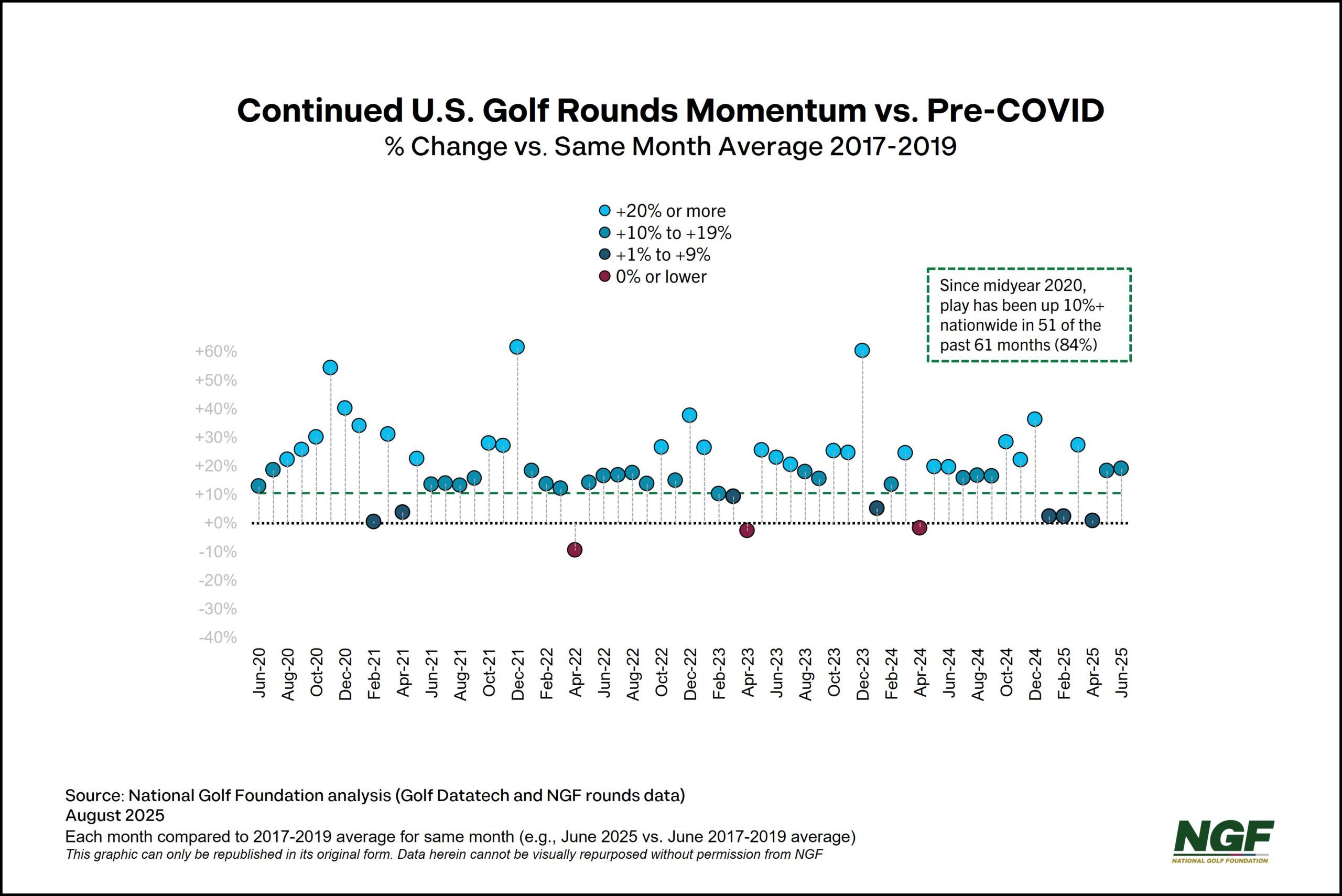
First, the ongoing positive swell of the golf industry. A summer 2025 National Golf Foundation report found that 26 peak-season months (May to October) dating back to 2020 have seen rounds rise at least 10% higher than recent pre-COVID comparisons.
That has been evident via busy weekend public tee time consumption in heavily populated metro areas, with total play halfway through 2025 trailing the record rounds mark of 2024 (545 million rounds played) by less than 1% and exceeding both 2021 and 2023, which were record setters prior to last year’s rise. Late summer and early fall may allow for another record season.
Additionally, GolfNow, the world’s largest tee-time reservation platform, has experienced record tee time bookings in multiple months and golf ball shipments are up 59% (a five-year record) against pre-COVID standards — two consumer indicators of a hearty appetite for playing in 2025.
In the 61 months since pandemic-related restrictions on golf were lifted, the NGF found that only three months failed to surpass 2017-19 monthly averages, mostly because of iffy weather in spring, particularly April.
Warning signs emerge
The weather factor was one metric that Pellucid Corporation used this summer to indicate a settling down was coming soon, a warning sign for how to prepare for golf’s next phase.
Weather issues halfway through 2025 curtailed playable hours by 5% as utilization dipped in June, the first full month decline in years. Operator observations indicated that practice facilities were full, but tee times were less packed. Also, younger golfers participated but not as frequently as older players that they replaced. It was deduced that it takes three younger golfers to equal one avid older golfer who is cutting back considerably.
Pellucid suggests that golf course operators must pay attention to pricing strategy, customer retention and shifting consumer behavior.
Pricing and planning ahead
Regarding pricing levels, high-priced destination golf at locations such as Bandon Dunes, Sand Valley and Kohler, Wisc., were thriving but local play may have shown some flattening indications as consumers embrace mid-tier “value” and “premium” experiences versus cheaper greens fees at daily-fee courses. Therefore, middle and higher-end courses remain solid while the bottom tier may be more affected by daily economic forecasts and a trimming of leisure spending.
One example of planning for the future regarding tee-time distribution can be seen within a recent and first-time golf economic impact study at golf hotbed Myrtle Beach, South Carolina, that found a $1.6 billion boost for the Grand Strand’s economy.
One Myrtle Beach property that has been prepared for this rise and what’s to come next is Legends Golf. The five-course company has implemented a layered approach to tee times that maximizes rates around long-window packages and wholesale partners while also having velocity subscription memberships and local loyalty card products at its Moorland, Parkland, Heathland, Heritage Club and Oyster Bay Golf Links courses.
“It’s a diversified approach with little risk and we don’t rely solely on any one segment,” said Kyle Moorefield, director of sales and marketing at Legends Golf, who uses Supreme Golf Solutions to develop this platform. “We learned a lot during COVID where, if anything, we doubled down on this approach. We invested in these markets, and it’s paid off for us where we stand now.”
Investment and renovation cycle
Aside from a tee-time strategy, Legends has also invested in its product with large-scale bunker renovations, new leases on maintenance and cart equipment, cart path work and the purchase and renovation of on-site condominiums for traveling golfers’ accommodations. A plan to redo greens on various courses may be upcoming.
This follows another trend of courses nationwide undergoing major course work, with golf development in its strongest cycle since 2010, totaling nearly 140 new course projects active or being planned. That consists of unseen but necessary drainage upgrades, short game and practice facility work, course renovations or additions and food & beverage amenities that appeal to players and keep them on site for longer periods of time.
Planning in advance is vital with this construction since there has been a cost escalation with tariffs and international trade policies, and many contractors are booked out at least two to four years in advance.
Larry Hirsh, president of Golf Property Analysts, suggests making “required” enhancements first before “desired” projects.
Moorefield, who expects a heightened Myrtle Beach travel market in 2026, said they are setting themselves up good for the future.
“We’re not naïve,” he said. “There are a lot of people in our golf bucket who may be hurting with economic situations and may not have the means to travel. But we’re prepared for that with this variety of options.”
Technological advances hold the key for Moorefield and should be a strong suggestion for all golf operators.
The technology gap
The NGF reports that only 40% of golfers are booking tee times exclusively or mostly online as compared to 80% to 90% online usage among customers who book flights, hotels and rental cars.
The lack of engagement is largely attributable to both consumer limitations and comfort with reserving and paying online because of an inadequate technology infrastructure and experience from the golf course’s site, thereby driving golfers to other courses or online booking platforms.
According to the NGF, many golfers who get frustrated with the online process resort to booking times via phone calls or in person, thereby hampering the golf staff, costing facilities millions of dollars in staff hours and preventing customer service necessities such as a focus on retention of customers via email follow-ups or managed check-ins.
With that grassroots technological base lacking, it’s evident that the next phase of the equation presents challenges.
Having a marketing or digitally trained staff person to handle such a load is deemed essential not only to make more profit but to have control of how the course’s brand and business is viewed in a digital world and to deal with the software provider on any issues. And that doesn’t include the onrushing technology of AI, which presents more opportunities and management. Making it simpler is the common goal.
“Golf is incredibly slow to adapt to technology,” said Chris May, senior vice president of Supreme Golf Solutions. “Most facilities were not equipped nor prepared to take advantage of the most inflationary periods following COVID. There is still a shocking amount of golf clubs that aren’t online in any sense.”
May is specifically referring to the reticence to use dynamic pricing products, data analysis and marketing tools to better understand the customer base, and products that more seamlessly orchestrate membership sales and administration.
All signs point to one central goal: keeping the customer happy. Operators should focus on retaining golfers by using data and AI tools to strengthen engagement. Pricing should avoid a race to the bottom by emphasizing value tiers and premium experiences. The on-site experience matters too, with practice facilities, food & beverage and amenities that extend each visit. Finally, operators need to adapt to generational shifts by encouraging younger golfers to play more often and build long-term loyalty.
(This story originally appeared in the November/December 2025 issue of Golf Inc.)