


Greg Nathan has been with the National Golf Foundation since 2007 and ascended to president and CEO in January 2024, succeeding industry legend Joe Beditz in leading the organization. One of the foremost experts on the state of the golf industry, Nathan has been recognized by Golf Inc. as one of the 25 Most Powerful People in Golf and works closely with CEOs and leadership teams from companies in every sector. Golf businesses value Nathan’s insightful perspective, broad and deep category knowledge, and a network of contacts that could challenge Kevin Bacon for degrees of separation.
What metrics does NGF track most closely to gauge the overall health of the golf business?
We describe ourselves as independent and objective reporters on the golf economy. Like any industry, the golf economy is made up of two parts: supply and demand. So that’s the natural place to start.
The need to deeply understand golf’s supply is one of the reasons we’ve always made significant investments into our databases — everywhere golf is played, retailers, club fitters, plus all locations for golf entertainment, driving ranges, and we’re tracking screen golf and technology-enabled ranges. We analyze the size, trends, how things are changing, and the type of investments being made to improve and diversify golf’s supply. Our focus is on the recreational golf industry, because as [NGF founder and World Golf Hall of Famer] Herb Graffis said, “It’s the recreational golfer from whom all blessings flow.”
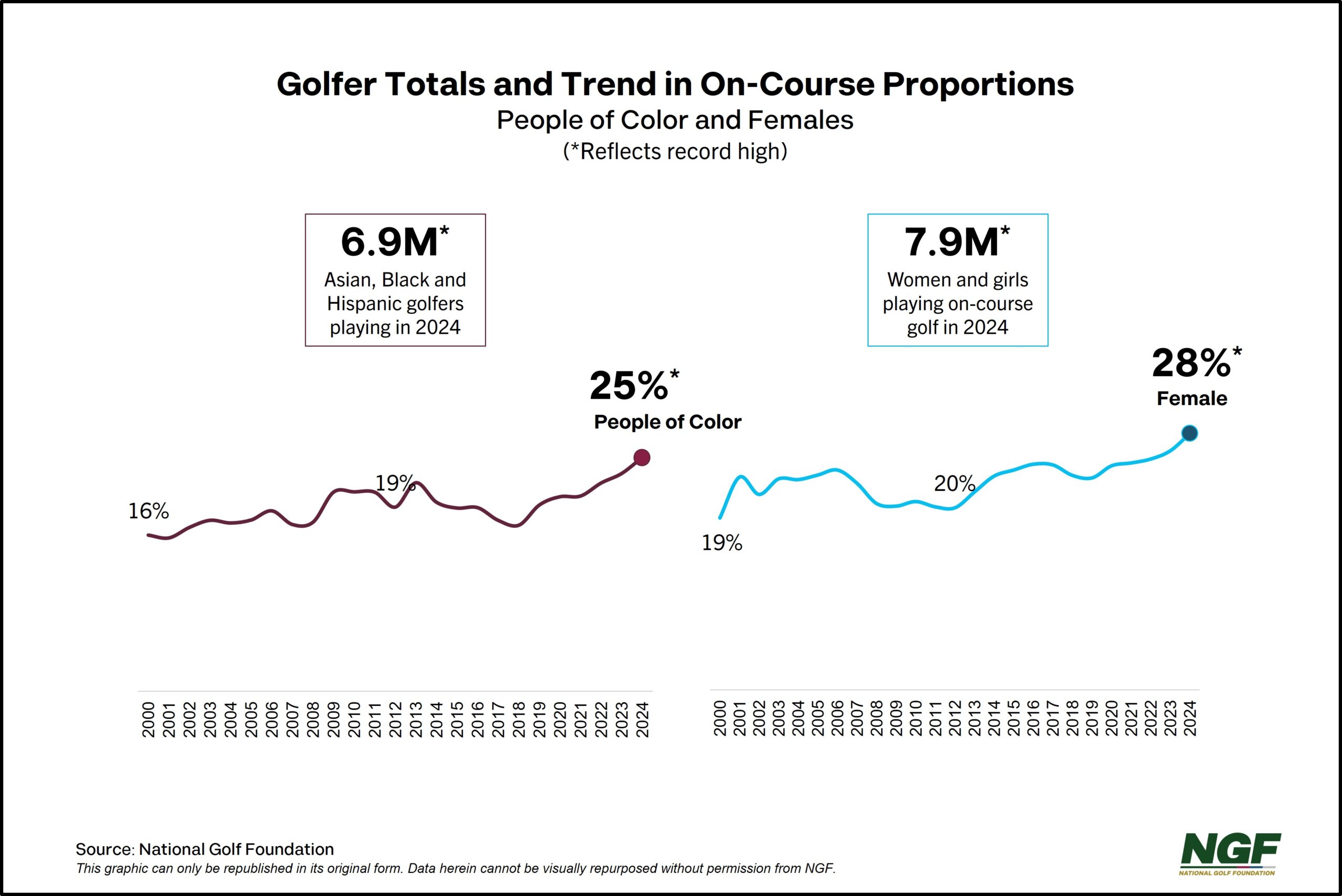
On the demand side, NGF invests tremendously in understanding who’s playing; demographics, engagement, growth areas – such as how we’re at the historical high-water mark in the percentage of green grass golfers that are female and people of color. We’re constantly analyzing different segments, but sometimes the segmentation can’t simply be explained in frequency of play or demographics. This is why NGF is digging deeper into behavior. Why do people do what they do? Why do some become hooked while others play only occasionally or only in off-course environments like Topgolf or screen golf? We’re evolving how we study golf consumers by understanding their psychology and motivations. In recent years, we’ve also tracked golfer and non-golfer engagement with social media and golf-related content and how they’re impacting golf’s image.
The NGF can be looked at analogously as a general practitioner, and the patient is very healthy right now. Within the golf economy, the vital signs are derived from supply and demand data, trends and insights.
Where do you think the most viable growth opportunities are, and how can the industry better attract and retain participants?
Many answers to the long-term health of recreational golf come down to understanding attrition and attraction. In other words, why some get hooked on the game and others play one or a few rounds and leave. The well-worn answers about golf’s difficulty, cost and time being deterrents are somewhat lazy. Looking at the psychology, we believe the biggest participation barrier lies in the intimidation and discomfort many people — especially novices, juniors, women, people of color — feel in the golf course environment.
Golf is a hospitality business, but often that isn’t the core focus of a golf operation. Facilities would gain significant advantage if they could identify which people walking through their door need more personal service and guidance. It’s about creating radical hospitality that makes even novice golfers comfortable in the golf course environment.
To retain more of the 2.5 to 3 million beginners who try golf annually, golf needs to compete with every other form of recreation and entertainment. It’s amazing… people prioritize things in their lives that are fun! Someone who perceives golf as fun will increase their engagement — that’s the plainest truth we can provide.
 In looking at golf’s recent successes (strong participation, play and perceptions), what kinds of things have led to this industry resurgence and are they sustainable?
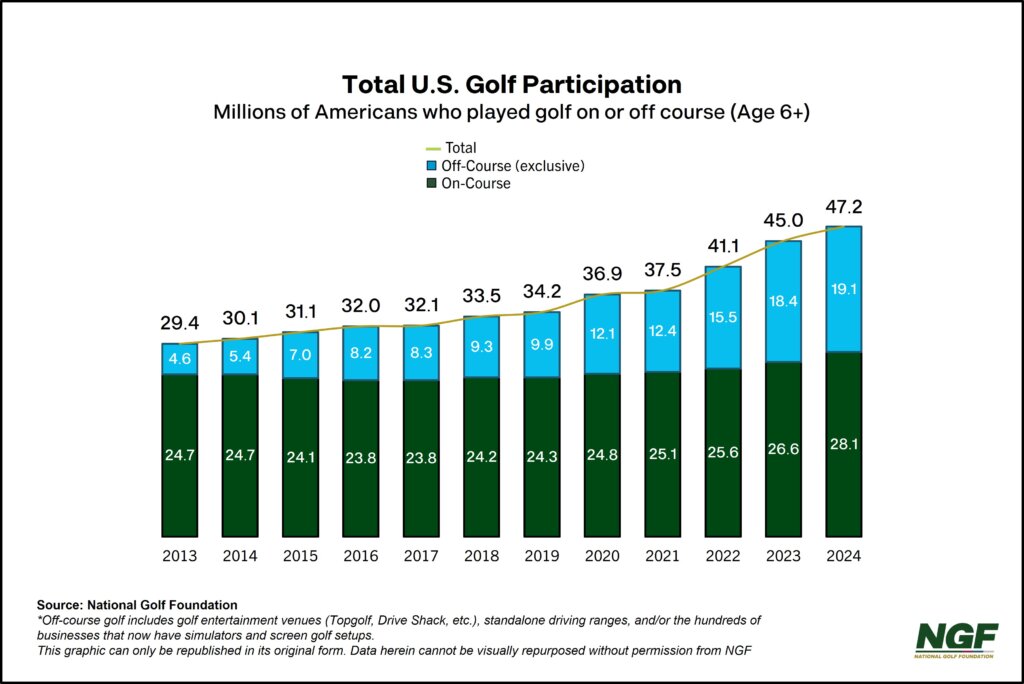
COVID was a meaningful catalyst, but prior to the pandemic, recreational golf’s key metrics were already improving following Great Recession declines. In 2017-2019, we were moving positively. When pandemic lockdowns occurred and golf was deemed acceptable and safe, it reactivated many people who had been marginally engaged, reminding them of golf’s intrinsic value – being outdoors, with friends, socializing, and getting exercise.
The current state isn’t just a COVID bump. Momentum continues because it revealed and reinforced what people love about golf, which aligns with what people need: outlets for socializing, exercise, nature, camaraderie and competition. We don’t see signs suggesting this surge isn’t sustainable. One cautionary mention: we’ve had favorable weather all but one year since 2020 and rounds played at some point will likely be negatively impacted by a year with greater precipitation.
Are emerging technologies (apps, simulators, data analytics, launch monitors & shot trackers, booking engines, etc.) changing how players engage with golf for the better?
Golf is about entertainment, and technology is a big part of the media and entertainment options people consume today.
There isn’t a sport that wouldn’t be delighted to have these different engagement methods.
We now have many ways to participate that are proving worthy of more time and money. Off-course, we’re far removed from analog stop-and-swat driving ranges. Now there’s tech influence with more data and gaming opportunities in many driving range experiences. The graphics and gameplay in simulators offer heightened realism; what a gift that is. It’s about entertainment, fun, and different ways to experience the game with tech enhancement — attracting both serious players and those who are less engaged.
On the facility front, yield management is an area of great progress. Technology has improved golf courses’ ability to optimize revenue for every tee time. It’s taken a decade-plus for yield management to reach the level seen in other businesses, like the airline industry, for example. Once a flight leaves, that inventory is dead — the same with tee times.
Other platforms allow operators to manage customer flow around courses: pace of play, food and beverage delivery, knowing specifically where groups are. There are also the technologies that individual golfers use, including apps, distance measuring devices, swing instruction, swing analyzers and AI. We’re just in the early stages of where all this could help engaged golfers get even better and greater entertainment value.
What is one area where greater coordination across the industry could lead to major breakthroughs?
NGF is uniquely positioned at the hub of the golf business wheel. We’re the only organization serving every vertical commercial business category as well as the governing bodies/associations.
We’re pursuing a variety of collaborations, including one with the Golf Course Superintendents Association of America on new methodology for water usage data accuracy. We work in a variety of capacities with the PGA of America, PGA TOUR, USGA and LPGA, supporting their delivery of golf to the masses and better understanding golf media and fan engagement.
The NGF’s base for industry collaboration is keeping the governing bodies and leading companies as well informed as possible relative to trends impacting their business today and in the future. That’s where we dedicate the majority of our collaborative efforts: asking questions and listening to differing perspectives so we can improve our work to support the industry.
What milestones would you like to see the NGF and the industry reach over the next five years?
We’re at the high-water mark for rounds played in America but haven’t matched the record number of green grass golfers — around 30.5 million in 2003. We’re at 28.1 million golfers producing record play levels.
So, there’s upside in traditional, on-course golf, as well as off-course participation. We’re somewhat saturated relative to traditional supply in the 385 or so U.S. markets due to prohibitive land and building costs in urban areas. As we approach tee sheet capacity in major metro areas, I expect continued growth in screen golf facilities and gamified ranges. There’s meaningful headroom to add facilities where people can participate in golf in different ways, maybe even some we haven’t thought of yet.
Another milestone would be improving measurement using new technology, particularly AI. We don’t spend time polishing our crystal ball, yet we’re constantly examining predictive trends. We’re in a unique position to lead those in the recreational golf industry with guidance on how AI can improve their businesses. That starts with proving how we can improve our own products and services using AI.
What are you most excited about, and perhaps most anxious about, for golf’s future?
I have anxiety that business success might disincentivize innovations in hospitality that would foster a more welcoming atmosphere. Because business is so good, it reduces pressure in terms of creating new golfers from non-golfers. Could success potentially slow this need, and therefore the necessary changes in making golf easier to approach?
From a recreational standpoint, I’m excited by the broadening of the participant base and investments across the game, including new properties in fantastic natural environments driven by passionate visionaries. In the end, it’s all about this game, the gravity it has and the unique passion it generates.