

Turf equipment manufacturers have been focused on delivering better value instead of innovation. But that doesn’t mean technology isn’t moving forward. It’s just further in the future.
by Jack Crittenden
At February’s Golf Industry Show in San Diego, vendors rolled out the latest and greatest in new products. And turf equipment manufacturers were no exception.
Jacobsen blanketed the San Diego Convention Center and the nearby streets with orange shirts, gift cards, Jacobsen-branded Pedicabs and orange muscle cars. It was all part of the Textron company’s effort to showcase six new and enhanced products, including the company’s new LF510 fairway mower and ECLIPSE 322 riding greens mower.
But while the marketing blitz was impressive, the new product line was modest compared to years past.
“Things are very tight for golf courses and the market doesn’t really want new stuff right now,” said Adam Slick, public relations and communications manager at Jacobsen. “New stuff comes with a 10 to 15 percent price increase.”
So for Jacobsen, and others, it is back to basics.
“We are focusing on how to save golf courses time and money with products that fit their budget,” Slick said.
The LF510 fairway mower, which Jacobsen unveiled on the first day of the show, is designed to provide a “great cut at an affordable price.”
The mower can come without the bells and whistles, keeping costs down, but still deliver good quality. Jacobsen’s goal was to provide the lowest price per width of the cut.
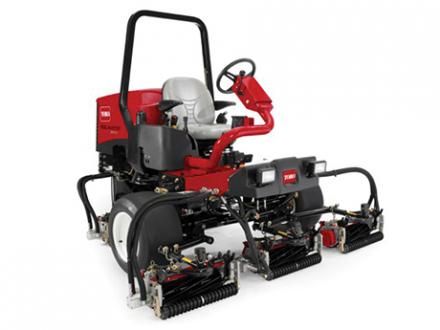
Toro’s recent innovations also are focused on saving time and money for the operator. It introduced the Reelmaster 3550-D, a lightweight mower that offers an 82-inch width of cut, compared to the 59-inch width of cut on a typical riding mower. It also mows 40 percent faster than other lightweight mowers.
“It takes a lot less labor, and golf course owners like that because it saves money,” said Bob VandenBoom, senior marketing manager at Toro.
While Toro’s new offerings lack the pizzazz of past years, the company has not placed innovation on hold. It has focused much of its resources on getting its fleet Tier-4 compliant with federal environmental standards. The Environmental Protection Agency’s regulations require diesel engines with 25 mph horsepower or greater to reduce emissions by more than 90 percent.
That has forced manufacturers to invest heavily into computer technology that can monitor and control the filtration system, fuel injection and other parts of the motor.
“The filter needs to be smart to know when it needs to be cleaned out,” VandenBoom said. “The computer control of engines allows for advanced diagnostics and preventive maintenance.”
John Deere has also invested much of its resources into making Tier 4 a smooth transition. Mark Ford, marketing manager at John Deere Golf, said that while his company introduced tighter turn radiuses for its mowers and aeration equipment that can shift on the fly, greater innovation is just around the corner.
“It will be around alternative fuels and energy, fleet management and more autonomy of machines,” Ford said.
John Deere has invested heavily into the agriculture side of its business, which is much larger than golf. It has experimented with GPS guidance, allowing machines to be autonomous. It also uses technology to more efficiently manage fleets, such as tracking how long a machine has been idle or when it needs maintenance.
Jacobsen is also experimenting with alternative energy sources. The ECLIPSE 322, its new greens mower, is powered by a lithium battery that provides enough power to mow 18 greens. A traditional lead acid battery will last for only nine greens.
“It is more expensive,” Slick said. “But the ROI (return on investment) would come back within the lifetime that you own it.”
The cost for lithium has been dropping about 25 percent a year, meaning that most fairway mowers could be powered by the advanced technology in five years.
“Technology is changing quickly,” Slick said. “We are trying to be backward compatible as much as possible so operators can upgrade what they have.”
But most of the new technology is still a few years off for the golf industry.
“Areas where technology can help are not where the rubber currently meets the road,” Ford said. “Alternative fuels — we will move that way in the long term. But not anytime soon. The industry can’t support the investment right now.”
But golf course operators are looking more long-term than in previous years.
“The economic downturn in 2008 required courses to be more efficient and look hard at the center of their operations to see where they make more money,” Ford said.
As a result, managers are more involved in the turf equipment purchase decision and focused on the bottom line, he said. They seek out multiple bids.
“When they have more data, they make better long-term decisions,” he said.
Leasing is also more popular than in prior years, as operators seek to free up capital for other expenses. An estimated 60 percent of all turf equipment is leased.
“It looks like 2013 will be a good year on the equipment side,” said Tom Barber, general manager for golf equipment finance at EverBank Commercial Finance. “There has been pent up demand. People pulled back after 2008 and have been running equipment longer – repairing instead of replacing.”
EverBank recently entered the golf market with hopes of capitalizing on the growing and stable market for turf equipment leasing. After three years of slow sales, 2012 was a good year for manufacturers. Jacobsen was up nearly 13 percent. And most expect sales to be even stronger in 2013.
And the sooner sales improve, the sooner manufacturers will be able to invest in new technology.