


The National Golf Foundation released a new Golf Participation in the U.S. Report that shows diverse player numbers heretofore unseen among underrepresented groups.
The data ending for calendar year 2024 shows that more than a quarter of on-course golfers are female or people of color: 28.1 million Americans played on a golf course in 2024 (itself the highest number since 2008) and the numbers show that 28% were female and 25% were Black, Asian or Hispanic. Both of those numbers are all-time highs and showcase how much the sport has changed and grown in the last few years.
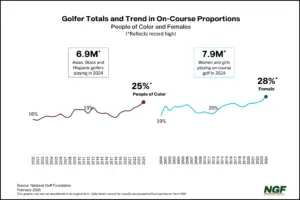
Using the COVID-19 pandemic as a starting point, the net increase of female and POC players is 2.3 million and 2.1 million, respectively. Women specifically have been a driving force in increasing the overall number of players, accounting for 60% of the net growth, with the female population reaching almost 7.9 million. This is another high-water mark, especially compared to 2012, when female golfers were a mere 20% of green-grass golfers.
Racial and ethnic diversity shows equally impressive growth. In 1990, people of color accounted for only 8% of on-course golfers. That number rose to 16% by 2000 due to the popularity of Tiger Woods. By the end of 2024, the number had reached nearly 7 million. All of these number reflect a shift in larger American demographics, with people of color comprising more than 40% of the general U.S. population.
Even off-course numbers show this same growth. Female golfers represent 43% of the 19 million Americans who only play off-course golf, with people of color making up 45%. Other data shows record numbers of golfers leaving the golf entertainment venues to try on-course golf for the first time.
All of these figures represent not only the overall health of the game, but also the success in broadening the appeal of golf to underrepresented groups.