

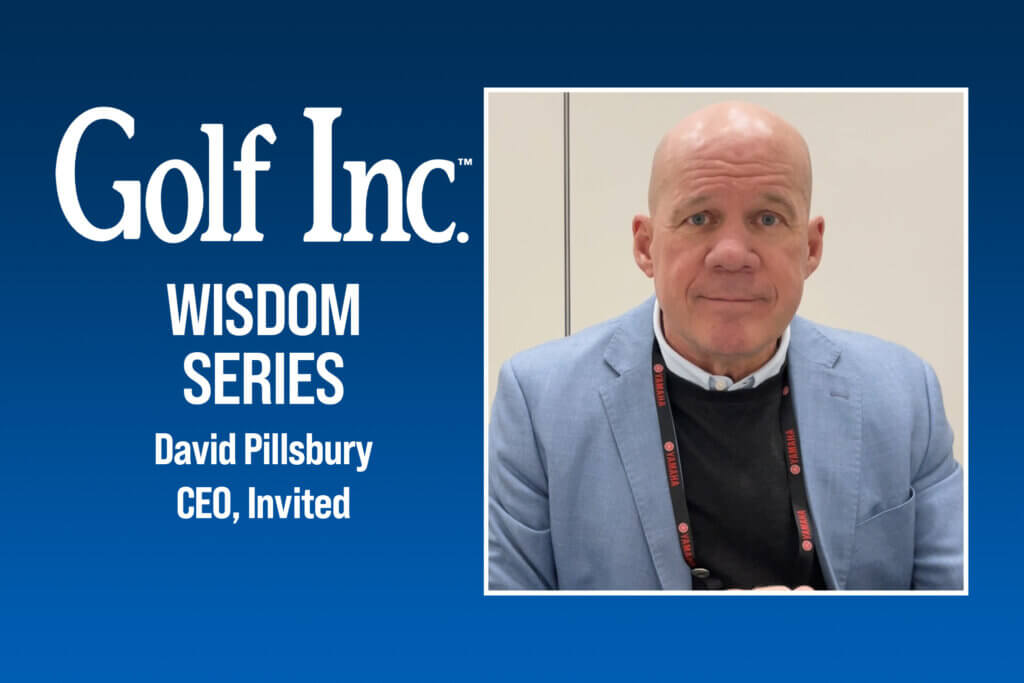
We sat down with David Pillsbury, CEO of Invited, at the PGA Show in January and talked about how clubs can best manage membership growth, what amenities they should offer, and the daily challenges they face in the current economic climate.
Full transcript below (lightly edited for clarity):
How should clubs manage waitlists and potential membership growth?
It’s a great question and I think it’s a great question because there’s no standard approach to managing wait lists. It’s kind of all over the map. In fact, I’m on a wait list for a club that’s an expensive club with a long wait list where you have no golf privileges, no social privileges whatsoever. You are literally separated from the club while you’re on the wait list and therein I think lies the magic of the best answer. It’s club by club, but I believe that every club has the capability of figuring out how to create some level of access for the waitlisted member to keep them engaged in the club. Now I say clubs are different. Some, they have no capacity in golf, so maybe there isn’t any room for a waitlisted golf member to play golf.
But I would submit to you that every club I’ve ever seen has excess capacity in some of the off-peak times. It might be Tuesday afternoon after 3:00 and maybe a waitlisted member can only play nine holes but keep them engaged at the club. And I wished I had that capability at the club that I’m waitlisted on because right now I get nothing. So I think it’s very important to keep the member engaged and I would say, from a pricing standpoint, even though I’m not in this situation where I’m waitlisted, I think it’s also good to at least provide a range of where you expect the initiation fee will be once you come up on the waitlist and you have to write that check. But the key, I think, is to keep that member engaged with some level of access at the club. It might only be social, and it might only be social off-peak. Fine, but keep them engaged.
What amenities should clubs offer beyond golf, and how would they be utilized by members?
So when it comes to amenities and what is relevant to members at clubs, it really starts with understanding the marketplace and what’s available in the market. Who are your competitors? What amenities do they offer? And then what is it your local consumer is looking for? And one of the best examples I could give would be around racket. One of the fastest growing sports in America right now is pickleball. So understanding access to pickleball courts, where are people playing, understanding whether or not that’s an amenity that could be relevant to the local marketplace is very important, but it applies to everything from aquatics and what sort of aquatic amenities you have. Do you have the ability to host swim teams? Is that relevant to your local market? Is there an opportunity there or is it just basically family fun and swim pads or splash pads and a play area for kids? Childcare has become very important for millennial members who are looking for a place to check their kids in while they enjoy whatever passion they’re pursuing, whether it’s aquatics, it’s fitness, pickleball, racket, all of which are outside the scope of golf.
Obviously, golf is relevant to all of these as well, so the club of the future offers a variety of amenities to appeal to a broader audience, and that’s really the key. Because within your local market, if you have the amenity package that people are looking for and they understand that they can actually afford to join a private club — many people just assume they can’t because they only hear about what it costs for golf, but what they really want is the lifestyle of a country club and access to these other amenities. So what we think about at Invited are the clubs that can’t afford to spend the capital to add the amenities. When we acquire a club, the first thing we do is we understand how to reposition that club with the relevant amenities to move it upmarket so that it’s relevant to a broader audience, and that’s exactly how clubs should be thinking about amenities as it relates to their members.
What are the biggest challenges clubs currently face in day-to-day operations?
I would say the biggest challenge for private clubs and golf courses just generally — and they very much relate to one another — is staffing and making sure that you’ve got the appropriate level of staffing to create the right environment for your members. That leads directly to the second and much more important challenge, which I think every club has, and that is getting out of the world of thinking about the membership interface as a transaction and thinking about it in terms of a relationship. When it comes to golf, the relationship between the golf professional, the golf professional staff and the member, are we playing golf with a member that is struggling with their game? Are we inviting them for coaching to take advantage of learning some new skills that will make the game more enjoyable? Are we taking advantage of offering them equipment that might make shot making a little bit easier so that they can enjoy the game more?
It’s not rocket science. If we extend beyond transaction and deepen a relationship with a member at a club, what happens? The member won’t leave. It drives retention and spending. In a transactional setting, there’s no motivation for the member to stay. And I ask people all the time, “When’s the last time your club called you when you haven’t been to the club in a month and invited you to play nine holes with the golf pro?” The answer for the most part is “Never,” unless you’re at an Invited club, because we actually do that. We actually track the activity of the member. If you’re not active, you become part of a care group. That care group gets given to our teams, our teams that are then required to pick up the phone and call you and invite you out for something we call a “play nine,” which is to play nine holes with the golf pro just to have fun. It’s not a lesson, it’s not an assessment, it’s just to come out and have a good time. We engage in all of those emotions which caused you to join the club in the first place, and it drives a 75% improvement in retention. That’s all, only 75%! So that’s the biggest challenge: staffing. Which means if you’re too busy to build a relationship, then you’re not staffed correctly. You have to have the time and the bandwidth in order to deepen the relationship with the member, because that’s how you drive member activity, which improves retention of members and drives member spending.