
Just as a detailed and thorough blueprint is critical for turning a building plan into sturdy reality, your facility’s sustainability success hinges on creating and executing a solid plan. At Audubon International, comprehensive, and science-based planning is at the heart of every certification program we offer, including our seminal Audubon Cooperative Sanctuary Program for Golf.
Before we embark on a certification path with a new partner, we make sure they have done one very important thing: Recognize that through the process and to continue their stewardship journey for years to come, it’s a team effort. If you’re the golf superintendent or the property manager, it’s okay to acknowledge that you can’t do it all yourself. To build a sustainability program with deep, healthy roots, you want to involve your general manager at the very least, in concert with your maintenance team, your greens committee or other club- or community-level environment committee or group. Working together, with across-the-board buy-in, will keep your program on track and moving forward, and your goals in clear view. That teamwork element is vitally important to establish right away.
The foundation: site assessment
Every Audubon International certification blueprint begins with a thorough Site Assessment and Environmental Plan (SAEP). It’s the “foundation” portion of the plan. In the golf realm, this is where a golf course superintendent most likely takes the lead, as they are familiar with the property’s characteristics and needs both above ground and below ground, including soil health, turf health, water conservation and quality, and energy use. How many acres is the entire course footprint? How many acres are actually in play? How many water bodies/water features are there, and what is their condition and function? Is the cart fleet gasoline-powered or electric? Is the mowing and maintenance equipment kept in good repair?
Getting a baseline assessment of these and other elements of a property’s operations, indoors and out, reveals the clear path to certification. It also gives you the inside track to long-term sustainability success.
Building blocks: dialing in details
Throughout the certification process there are many opportunities to bring in an individual or group to help create a complete, detailed picture. Water testing, wildlife inventories, and case studies are great projects for college interns, club members, or HOA neighbors. Perhaps there’s a retired college professor or business professional with a science-based background who can lend their expertise.
In terms of taking wildlife inventory, we love to see our partners recruit local college interns to help observe wildlife activity and collect data. Not only do these projects work particularly well with the usual six- or eight-week schedule for intern placements but you can also introduce another generation to the positive ways golf contributes to the environment.
Volunteers continue to be important for many clubs even after they’re certified and have created vibrant wildlife areas. For instance, one ACSP member in New Jersey continues a great bird program thanks to one dedicated member who built all the bird houses, checks and maintains them every year, and performs annual population inventories. His volunteer hours take that work off the golf maintenance team’s plate.
Recruiting volunteers and interns also helps to keep a “healthy” blueprint budget-wise. Though there may be some up-front expense in terms of staff hours spent on training, once they’re up to speed and take ownership of their tasks, it’s an obvious cost-saver in the short term and will reap benefits over time, in many ways.
One short-term benefit comes on the wildlife assessment front. An accurate wildlife inventory is key to a successful blueprint and fills out the larger environmental picture for all golf courses. It’s an indicator of how healthy and sustainable your course is. You wouldn’t have indigenous species nesting, creating dens, reproducing, or living on your course if it wasn’t a good environment for them. Some Audubon International members are even home to endangered species, or those of special concern. If a course is in an urban environment and it’s one of the few green spaces left, or it’s a migration corridor, certain native species — amphibians, birds, mammals — will find their way back.
Offer lots of doors
A healthy home for our fellow earth-dwellers also means a healthy environment for even more member, stakeholder, owner, and public buy-in. Many private and public golf courses enjoy relationships with local environmental organizations and “friends of” clubs. It’s a public park dynamic applied to a different kind of “park”: your golf course.
Again, growing that support network both inside and outside your organization is like building a welcoming and supportive “wing” into your blueprint. It’s easy to find people with negative attitudes toward golf, so you need to have people constantly talking about the positive things that golf does for the environment, for health, and for the community. It could be a simple matter of a nearby resident saying, “I get my exercise by walking 10,000 steps a day, which is easy to achieve during a round of golf,” to inviting retirees to help maintain pollinator fields, to bringing in local groups to help count species. Audubon International sponsors a “BioBlitz” event each spring that’s great way to do just that, as is the Golf Course Superintendent Association of America’s series of “First Green” programs that are ready to implement out of the box — perfect for volunteers.
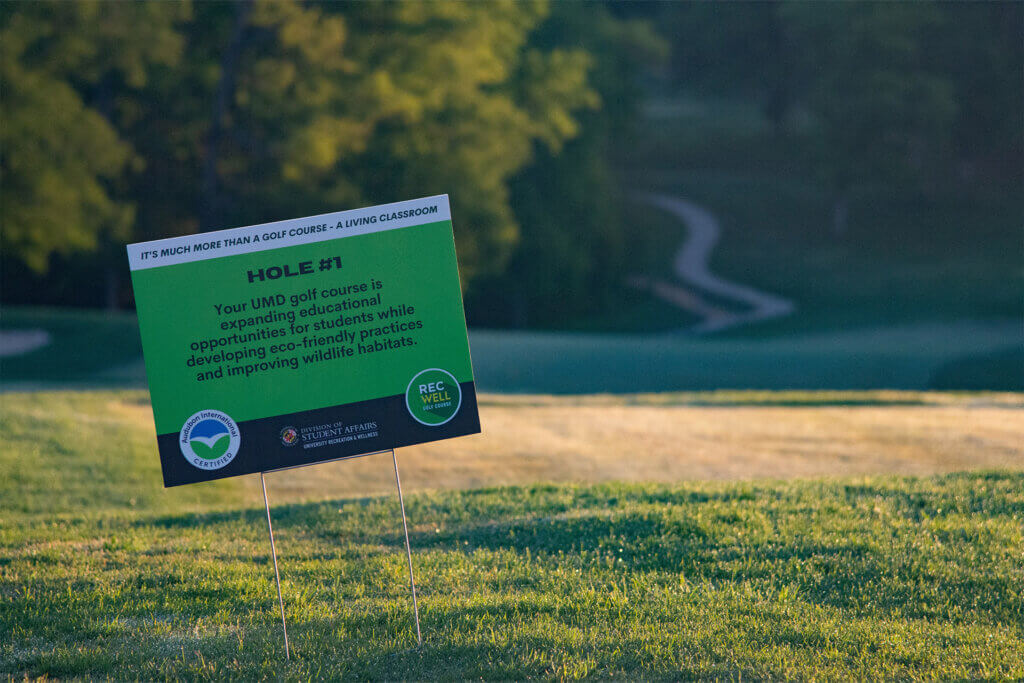
It’s all part of what we call Outreach and Education, which is intrinsic to every certification program we offer, involving everything from simple signage pointing out native areas and pollinator zones, to newsletters dedicated to stewardship practices. The point is to tell people you’re doing great things for the environment, and how and why you’re doing it, which will help them appreciate your efforts, feel better about their club membership, and hopefully be inspired to work similar practices into their daily lives. Plus, they become your best evangelists, spreading the “good news” to friends, neighbors, and fellow members who may still have reservations, rather than your superintendent having to field those questions or concerns every time he or she makes his way through the clubhouse, or out on the course.
The roof: connecting it all
The bottom line in creating a great blueprint that everyone can see and understand? People who want to see the final result and get involved. They’re looking for community. They’re looking to contribute in whatever way works for them, whether it’s a retired person l creating an environmental committee to support you or a student looking for a research project or community service project to help build a resume. When you have developed that deep well of support, enthusiasm will grow for even more sustainability strides. A general manager might be more willing to consider or budget sustainability projects if they’re coming from the members.
As a respected third-party certification partner, Audubon International is, in some sense, both architect and contractor. We offer clubs answers to the inevitable questions of, “Who helped you do this, and why? And how did you get it done?” The SAEP is the foundation, followed by each step along the route to certification: building the walls, windows, and doors of a strong stewardship structure, and adding a roof of outreach and education. We help you draw up the plan and bring it all together.