


After a round of golf, most golfers remember a great green or cool bunkers, but we don’t often reflect on the teeing options and how well they fit our game. However, playing from a set of tees that matches our hitting distance, skill level, and challenge preference plays a big role in the variety of shots encountered, scoring, pace of play, and our overall satisfaction. As simple as it might seem, the teeing options a course offers and the one we choose has a substantial impact on our experience.
While tees have always been important – and somewhat overlooked – they have taken on new significance in recent years as more people are playing for the first time. According to National Golf Foundation (NGF) data, a record 3.3 million beginners entered the game in 2022, the third-straight year where that number was higher than 3 million and the ninth-straight year above 2 million. In addition, 3.4 million juniors played on a golf course in 2022, a jump of 36% in the last three years. Are all these new and young players finding tees that offer a reasonable challenge? Do they know how to choose the best set of tees for their game? What about experienced golfers?
Over the past several years, USGA researchers and our industry partners have studied the existing supply of tees on U.S. golf courses, how golfers use them, and golfer attitudes about tee selection. This research highlighted multiple opportunities for improvement – some involving physical changes to golf courses while others involve changing our attitudes and how we talk about tees. Using this research, we developed and started testing a new prototype system to help golfers choose a tee that matches their ability on any course they play.
Below are summaries of three key areas of our research with the most important findings.
Tee availability and use on U.S. golf courses(1)
Golf courses in the United States vary in total course length from under 1,500 yards to over 8,000 yards for 18 holes. The median back tee is 6,518 yards and the median forward tee is 4,952 yards. As front tees get shorter and back tees get longer, on average there are more teeing options available and more scores are posted by golfers per course. While adding teeing options on either end of the spectrum increased score posting, having shorter forward tees accommodates more golfers than having longer back tees at many golf courses because tees longer than 6,800 yards are rarely utilized.
Using a variety of existing tee recommendation systems(2,3,4) to evaluate golfer tee selection decisions based on score posting data, there is a strong indication that most golfers play a course that is too long for them – either by choice, or because there isn’t a tee available that matches their hitting distance.

Forward tees for the future(5)
Shorter hitters and players with slower swing speeds are a critical part of the golfing population that has been growing rapidly in recent years; however, the forward tee yardage at most golf courses in the U.S. is too long for many players based on their hitting distance and preferred challenge in a round of golf. A forward tee distance that is closer to 4,000 yards than 5,000 yards is a better fit for far more players – including the average female golfer and many others with slower swing speeds. Unfortunately, more than 40% of U.S. golf courses do not have a forward tee less than 5,000 yards.
Providing forward tees that better meet golfer needs is one part of the equation, but getting golfers to use forward tees is also important. Some of the stigmas that discourage people from using forward tees can be reduced through design, presentation, identification and course rating. Tees with a gender or age identifier in the name are an obvious issue, but golfers also associate certain tee colors or locations with particular groups. While the USGA and The R&A have required that all tees shorter than 6,000 yards are rated for both men and women, implementation may take several years. Not having a tee rated for both men and women can not only deter players from using forward tees from a score posting perspective but can also influence the messaging around forward tees. If tees are not rated for male players, it reinforces the stigma that forward tees are “ladies’ tees.”
Changing identification is an easy way that courses have diminished stigmas and increased use of various tee sets. Some courses have simply altered the traditional order of their tee colors to help golfers feel freer in their choices. Also, tee markers don’t need to have a color at all. Instead, some courses use a number or symbol system to identify their tees.
Golfers do expect comparable presentation and conditioning across teeing options. 78% of respondents in a survey of 20,000 golfers said that consistency in tee box construction and quality would have either a “significant positive impact” or an “extremely positive impact” on their satisfaction, which likely translates into their willingness to use various teeing options. Our survey of golf professionals confirmed the importance of forward tee presentation and the potential impact on overall use. Of the 740 professionals surveyed, 82% felt that offering comparable presentation and conditioning on all sets of tees made it more likely that players would choose the set that best fits their game.
Helping golfers choose their “best tees” (6)
Although 99% of PGA and LPGA professionals we surveyed believe that golfers have a better experience when they play tees that fit their ability, 93% of that same group of professionals also said it is “extremely common” or “somewhat common” for golfers to choose tees that are too long for their ability. This belief is supported by survey data from golfers, analysis of USGA score posting data, and anecdotal experience. So despite the industry’s efforts over the years, a significant opportunity for improvement still exists.
The USGA worked with a range of golf organizations and industry partners to develop a prototype tee recommendation system based on golfer performance data and golfers’ stated preferences for approach shot distances. We started with this simple definition: “A set of tees is a good fit for a golfer’s ability when it allows them to comfortably reach the fairway on par 4s and par 5s, reach the vicinity of most greens in regulation, and allows them to hit a variety of clubs on their approach shots.” By combining this definition with golfers’ stated preferences for approach shot distances, we developed a prototype “Best Tee” system that, if implemented, can be helpful in recommending a good teeing option based off a single reference club. We selected a 7-iron because golfers have a good estimate of their hitting distance with this club. The system is fully customizable to fit each individual course and is currently being tested before any final recommendations are made.
The table below shows the median hole lengths and recommended par-72 course lengths for the average male and female golfer based on the average 7-iron distance for those players.
| Average Male Golfer | Average Female Golfer | |
| Average 7-iron Distance | 138 | 100 |
| Reasonable Par-3 Distance | 152 | 109 |
| Reasonable Par-4 Distance | 359 | 259 |
| Reasonable Par-5 Distance | 476 | 353 |
| “Best Tees” Recommended Par-72 Course Length | 6,100 | 4,437 |
As shown in the following pie charts, playing from a set of tees that allows golfers to hit a variety of approach shot clubs – and not always the longest clubs in their bag – is what the vast majority of golfers want. Eighty-five percent of golfers said that playing a balance of shots during their round would have a “significant” or “extremely positive” impact on their round and 76% either agreed or strongly agreed that it was important for them to experience the designed strategies of the course. These goals are hard to achieve when golfers play from tees that are too long for their hitting distance.
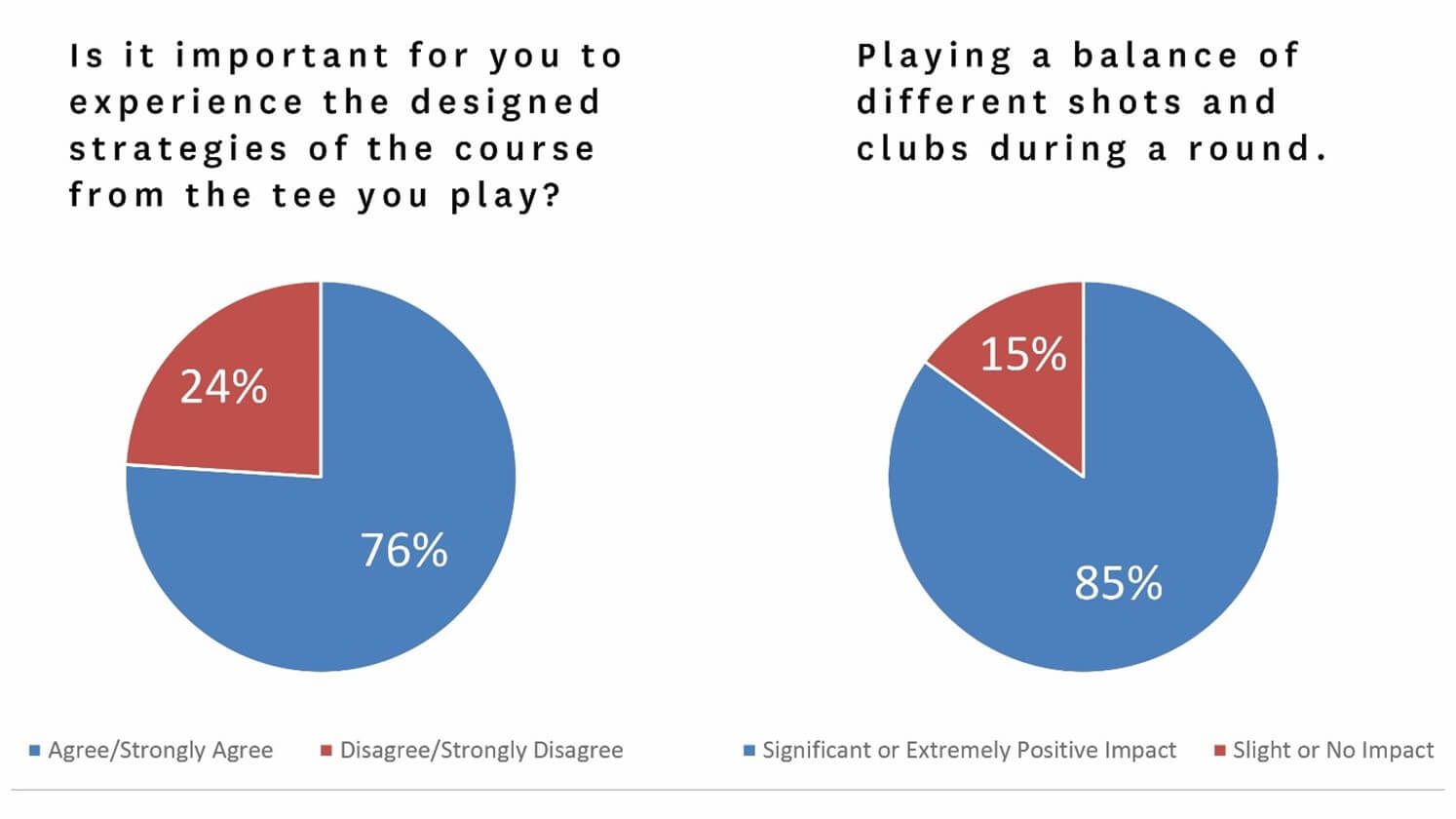
The reality is that many golfers have become accustomed to a version of golf that is more difficult and less varied than it needs to be. Many golfers cannot reach greens in regulation with even their best shots, they repetitively hit the longest clubs in their bag, and they seldom have a good opportunity to make par. Golfers want to feel challenged and want to improve their game, but often they are playing from too far back to ever achieve consistently good results.
Golfers who do not currently use tees that are a good fit for their hitting distance often have some reluctance about moving forward, even when those tees are clearly a better option. However, in a recent survey we asked golfers the following question: “If the golf course suggested a particular set of tees for me to use based on my skill level, and if it was different than where I typically play, would I follow that advice?” 53% said yes! This increased to 59% when they were shown a prototype of the “Best Tees” system. This willingness represents a substantial opportunity to improve golfer satisfaction!
Note: the “Best Tees” prototype system is being tested at over 60 courses across the United States in 2023 to gather feedback prior to wider distribution in the future.
George Waters is the senior manager of education and David Pierce is the director of research for the USGA Green Section. The Green Section develops data-based solutions that advance golf by helping courses improve golfer experience and resource management.
The USGA offers services and tools to evaluate golfer satisfaction. Contact the USGA Green Section at golferexperience@usga.org for more information.
References with additional details:
- Supply and Demand for Tees: Tee Options on Golf Courses: Supply, Demand and Opportunities (usga.org)
- Longleaf system: http://www.longleafteesystem.com/#our-purpose
- Tee It Forward system: https://pdf.pgalinks.com/p-g-a/Tee_It_Forward_Guidelines.pdf
- Set-up for Success system: https://orpga.com/wp-content/uploads/2021/02/PGA-Setting-up-course-for-success.pdf
- Forward Tees: Forward Tees for the Future (usga.org)
- Best Tees: Helping Golfers Choose Their “Best Tees” (usga.org)