


A golf course renovation can create excitement, revive a tired property and strengthen its competitive position. It can also consume capital without fixing the problem that prompted the work. In today’s high-cost environment, the difference often comes down to what ownership does before approving a design, setting a schedule or asking for bids.
Forrest Richardson, principal of Forrest Richardson Golf Course Architects, said owners need a plan they can measure, quantify and price. Richard Mandell, architect at Richard Mandell Golf Course Architecture, adds the importance of focusing on the reason for the renovation. Cory Blair, sales and business development manager at CapillaryFlow, frames the decision as a test of need versus want.
Together, their advice is direct: Define the problem, calculate more than the visible payoff and make sure the property can support the result after construction ends.
Start with the problem, not the project
Owners often begin with a proposed solution: rebuild the bunkers, replace irrigation or restore greens. Mandell urges them to step back and ask what is actually failing. Poor drainage, aging infrastructure, excessive maintenance or a deteriorating player experience may justify investment. A cosmetic complaint may not.
“It’s best for a renovation to come from an objective point of view versus subjective,” Mandell said. “What’s the true need for the renovation?”
His firm’s Renovation Business Plan combines course analysis with interviews and walk-throughs involving maintenance, staff, management and a cross section of players. The goal is not merely a rendering but a game plan with priorities, timing and cost estimates.
Richardson makes a similar case for planning before pricing.
“Until you have something on paper that you can measure, quantify and estimate, you are really shooting in the dark,” Richardson said. “Once you have plans, it’s possible to weigh them against revenue and potential.”
That plan should place the proposed work within a larger capital sequence.
Blair has seen clubs renovate bunkers, then damage them while rebuilding greens two years later. He has also seen courses invest in new turf while relying on an irrigation system near the end of its useful life.
“There’s a phasing that has to happen so we’re not paying for things twice,” Blair said.
The strongest clubs, he added, work from long-range master plans that look well beyond the next budget cycle.
Price disruption, not just construction
The construction estimate is only part of the investment. Owners also must account for lost rounds, temporary greens, member inconvenience, staff demands and the risk that a prolonged project weakens the experience they are trying to improve.
Richardson said nearly any renovation can be phased to keep a course open, but doing so can lengthen the project and increase costs. One current project, he said, could cost roughly 50% more if stretched across three years instead of being completed during a one-year closure.
“Every single project is unique,” Richardson said. “You have to consider the emotions, the finances and taking care of members.”
Rising costs also make early coordination essential. Richardson said the architect is the logical individual to bring together agronomy, irrigation, construction, operations and ownership before the scope is fixed. Weather windows, contractor availability and access to materials can affect price and schedule, especially in remote or short-season markets. Owners should test those constraints while alternatives remain available, then build a contingency into the budget rather than treating every late discovery as a surprise.
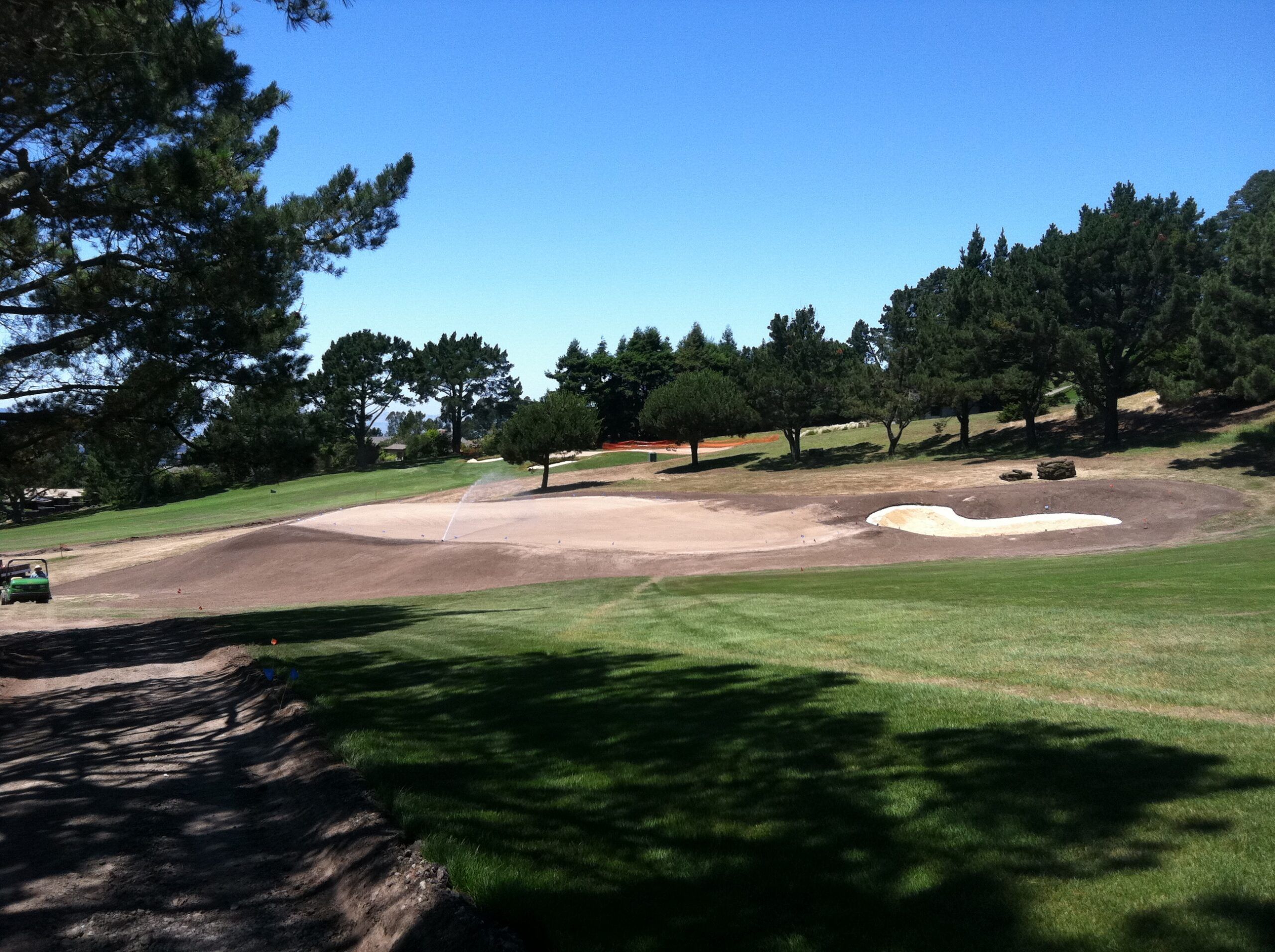
At Berkeley Country Club in California, keeping the course open was a firm directive. Richardson’s team worked around play with detours and temporary greens. Elsewhere, severe deferred maintenance may make closure the better financial decision, particularly if the course is already losing money and disappointing customers.
Market conditions matter, too. A daily-fee operator with nearby sister courses may redirect players during construction. A remote facility with no convenient alternative may not have that option. The decision should compare the value of limited operating revenue with the added cost, construction time and reputational risk of remaining open.
Expected life cycle: How long should parts of the golf course last?
Component life spans can vary depending upon location of the golf course, quality of materials, original installation and past maintenance practices. ASGCA encourages golf course leasers to work with their golf course architect, superintendents and others to assess the longevity of their particular course’s components.
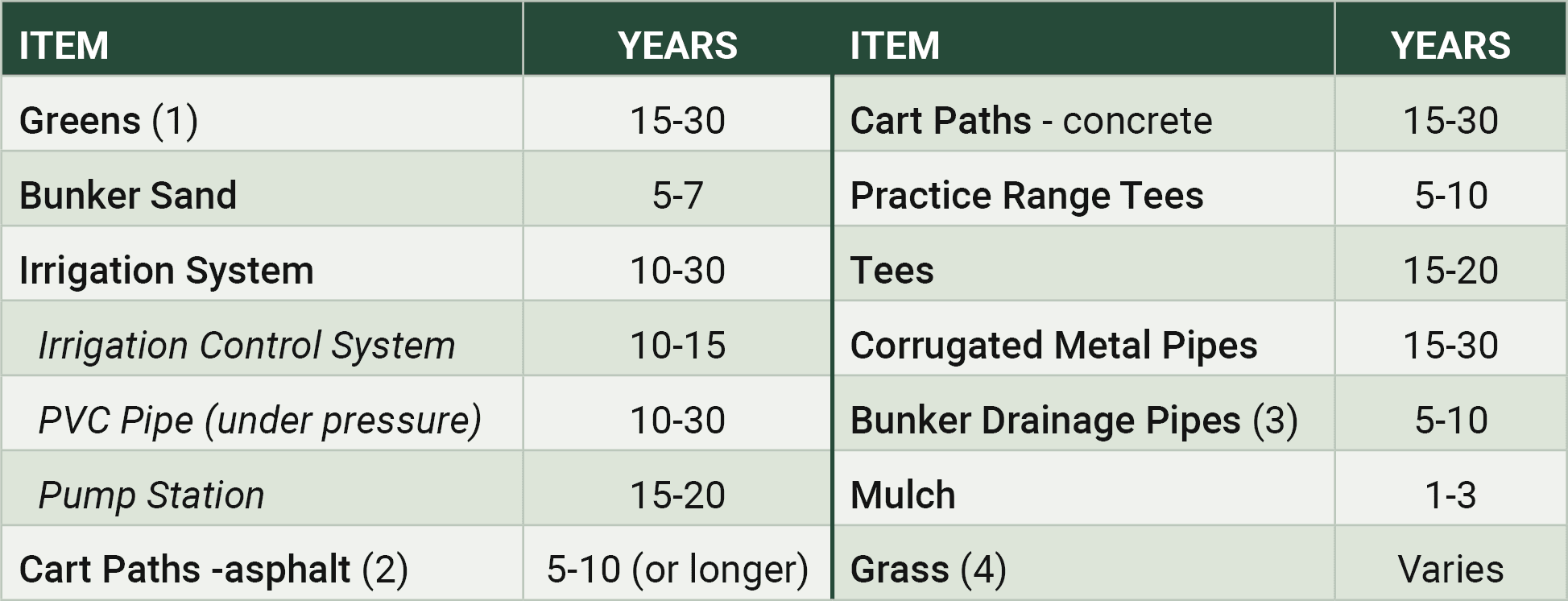
NOTES: (1) Several factors can weigh into the decision to replace greens: accumulation of layers on the surface of the original construction, the desire to convert to new grasses and respond to changes in the game from an architectural standpoint (like the interaction between green speed and hole locations.) (2) Assumes on-going maintenance beginning 1-2 years after installation. (3) Typically replaced because the sand is being changed — while the machinery is there to change the sand, it’s often a good time to replace the drainage pipes as well. (4) As new grasses enter the marketplace — for example, those that are more drought and disease tolerant — replanting may be appropriate, depending upon the site.
Source: Data compiled from ASGCA
Build support before asking for approval
Member expectations can make or break a course renovation at a private club. Blair warns that a 51% to 49% vote is not a mandate. A narrow win can leave nearly half the membership angry about an assessment and skeptical of management.
“If the membership isn’t behind it, you need to hit pause,” Blair said.
Focus groups and meetings with women’s and men’s associations, staff and other stakeholders can reveal the hot-button issues eroding support. Adjusting the scope may move a proposal from a divisive vote to broad acceptance.
Richardson uses workshops to separate what different groups want from what field conditions show the property needs.
“It might be the most important role of an architect, helping to set priorities, all based in real-world cost versus real-world returns,” Richardson said.
The process does not promise unanimity. It gives ownership evidence to explain why unseen infrastructure may take precedence over a more visible clubhouse or course enhancement. Clear communication also helps members understand the order of work, the expected disruption and when they will see benefits.
Measure the whole return
Renovation ROI is rarely one number. Increased rounds, higher dues or green fees and stronger membership demands matter, but so do labor savings, fewer emergency repairs, lower future capital reserves and improved property value.
Richardson describes the return as a pie chart. Some slices, such as new revenue, are easy to track. Others are less obvious. A longer-lasting bunker liner, for example, may push the next replacement further into the future and reduce the amount a course must reserve each year.
Blair points to bunker work at a lower-budget daily-fee course as an example of putting capital where the operational gain was greatest. That course had fewer employees than the operator’s premium properties, so repeated washouts pulled a large share of the staff away from other work. After renovation, those employees could focus elsewhere following storms.
Based on data CapillaryFlow has collected from courses, Blair said the average return on a bunker renovation is about two to 2 1/2 years from labor savings alone. The lesson is broader than bunkers: The best investment may be at the property where a recurring failure consumes the largest share of limited resources, not necessarily at the flagship.
Mandell said owners should look for multiple returns rather than justify a project solely on maintenance savings. One of his renovation projects was at Bobby Jones Golf Club in Sarasota, Florida, where the facility was reduced from 45 holes to 27. The change lowered maintenance costs while a Donald Ross restoration created a new experience for golfers.
Know when the risk does not pay
A project deserves another look when its purpose is vague, its sequence is wrong, its operating budget cannot protect the improvement or its supporters have not built meaningful consensus.
Mandell recalls a North Carolina course that rebuilt its bunkers but did not adjust the maintenance budget. The bunkers fell into disrepair again. Capital solved the immediate problem, but the operating plan could not sustain the improvement.
He also challenges the assumption that every aging feature demands immediate replacement.
“If you’re making money on your golf course and your infrastructure is functioning decently, you may not want to renovate your course yet,” Mandell said. “Just remember the cost will be higher tomorrow than estimated today.”
This article originally appeared in the November/December 2026 issue of Golf Inc.