


A quiet evolution is underway on fairways across the United States, powered not by new turf or tees but by AI and big data.
Few forces have reshaped club operations as profoundly. These technologies are drawing more golfers to the game, converting occasional players into loyal members and steadily boosting repeat play. The financial impact is unmistakable: revenues are climbing, and the trajectory continues to point upward.
The most powerful advantage behind this tech surge comes down to one thing: detail. AI and big data are giving operators unprecedented visibility into their businesses, pulling insights from CRM systems, digital ad platforms, mobile apps, POS terminals and even tee sheets.
Those insights are now being transformed into sophisticated marketing strategies. Automated workflows, predictive modeling and behavior based targeting are replacing the old playbook of broad, one-size-fits-all promotions. Clubs and courses are shifting toward precision, reaching golfers with messages tailored to how they play, spend and engage.
Technology providers such as Courserev.ai, Fairway Finder, Metolius Golf and Sagacity Golf are leading this shift. To understand how their tools are shaping the industry’s next chapter, Golf Inc. spoke with representatives from each company.
Courserev.ai enhances bookings
According to founder and CEO Manna Justin, Courserev.ai provides operators with a voice AI platform that will automate their tee time booking processes long term. Using advanced AI solutions, Courserev.ai complements golf management software (GMS) and tee sheet systems, while also utilizing its own Courserev Zero tee sheet and booking system.

“It uses hundreds of cloud computing instances, most major AI models (Gemini and OpenAI), structured and unstructured data and databases (Mongo) as well,” Justin said. “While working with multiple telephone or connectivity partners, it works with payment processors like Fiserv and Stripe too; its primary GMS integrator is Lightspeed Commerce.”
Capable of handling calls and acquiring course bookings 24/7, via its Voice AI Agent, Courserev.ai can take over 50 calls simultaneously. Offering chat agents (Course Agent and Course Agent Pro) through its website or mobile app, Courserev.ai also provides an advanced web booking system.
“This helps golf facilities proactively sell tee times to older and younger demographics,” Justin said.
By using Courserev.ai, clubs and courses can solve three key issues: time, talent and training, especially as labor shortages increase for many jobs.
Clubs and courses are saving an average of $40,000 to $120,000 for labor costs annually. And they’re recording 19% increases averages in after-hours booking revenue while also diminishing their no-shows.
“Courserev.ai will continue to improve clubs’ and courses’ bottom lines by driving more golfers, handling booking processes more easily and improving sales,” Justin said. “By adding features like splitpay, it will steadily push the growing trend of prepaid booking as well.”
Fairway Finder increases market visibility
When Ryan Walsh thought about how most courses handle marketing, he kept coming back to the same issue: Operators want to market smarter, but they rarely have the time or bandwidth to spend hours on it. Their days are filled with course conditions, daily operations and staffing, so marketing takes a back seat.
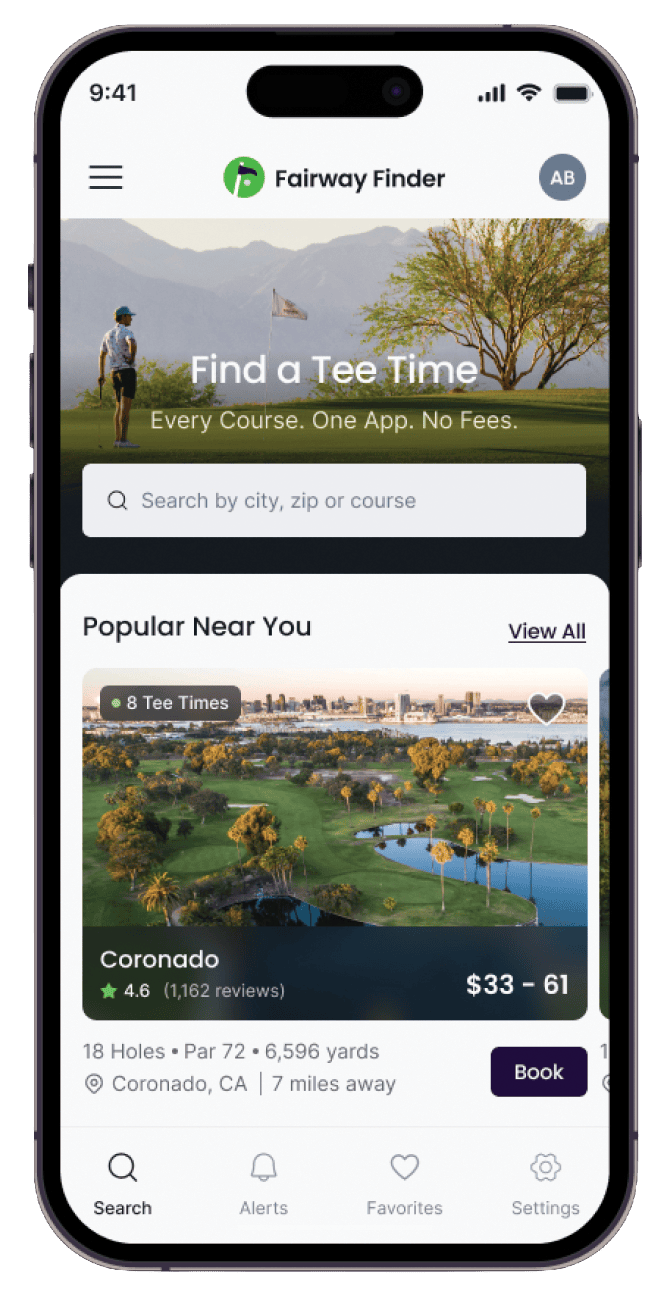
That reality is what led Walsh to create Fairway Finder. He set out to build a platform that could pull tee time availability from a scattered golf ecosystem and bring it all into one unified place. The idea is simple but powerful: Golfers can now find and compare tee times without jumping between a pile of apps and websites.
“For golf’s future growth, it’s critical to reduce this friction,” Walsh said. “It will benefit operators across the board.”
Unlike CRMs, digital ad platforms, mobile apps, POS systems or tee sheets (which are “inherently inward-looking,” according to Walsh), Fairway Finder plans to offer operators “an external demand layer.” Through this layer, operators will gain a real-time view on how demand and pricing are shifting regionally and nationally.
“When internal data is combined with broader market visibility, operators have a much more complete picture of performance and opportunity,” Walsh said. “That’s where more informed, strategic decisions can be made.”
Fragmentation, whether golfers are struggling to find tee times or operators are seeking more visibility about the broad market, will be less of an issue. Golfers will discover tee times more easily, and operators will have more outside demand and pricing insights.
It helps fill tee sheets by putting courses in front of more golfers.
“That incremental demand, driven by reduced friction, will fill more tee sheets. And the added insights will help operators make smarter decisions,” Walsh said. “When both sides win, the entire golf ecosystem benefits.”
Metolius Golf offers “operational data layer”
Ross Liggett created Metolius Golf to help operators implement their marketing and revenue initiatives more efficiently. He said the data platform integrates with a variety of systems, including POS systems and tee sheets, to extract and aggregate data, providing the user with a “clean operational data layer.”
Liggett said operators acquire assistance through this layer as they manage the four Ps of marketing: product, price, place and promotion.
When it comes to products, operators obtain data about how their customers respond to offerings like events, members and tee times. Regarding price, Metolius Golf analyzes how clubs’ and courses’ pricing changes influence their customers’ and members’ demand and revenue. For place, the platform evaluates operators’ distribution channels, while providing data about which segments are being booked at various channels, price points and conversion rates. And for promotion, the clubs’ and courses’ communication channels are measured to determine how they impact bookings, revenue and website visits.
“Instead of just tracking engagement metrics like ‘likes,’ operators can see the full path from campaign to revenue,” Liggett said. “Historically, many facilities ran marketing campaigns without clear objectives. Metolius changes that.”
How so? According to Liggett, Metolius Golf connects clubs’ and courses’ marketing campaigns to their specific business goals, from filling tee times and generating membership leads to increasing event bookings and selling annual passes.
“Our team works alongside operators to plan and execute these campaigns,” Liggett said. “We offer specialized marketing expertise that many facilities simply don’t have internally.”
The bottom line? Metolius Golf democratizes data across a club or course, enabling operators and their team members to visualize exactly how their decisions influence their revenue outcomes.
“When teams understand how their actions impact revenue, they can improve their marketing effectiveness more quickly,” Liggett said.
Sagacity Golf transforms tee sheets
When Mike Loustalot co-founded Sagacity Golf, he had two key facts in mind. First, tee sheets are typically golf facilities’ most important data sources. Second, far too often, that data isn’t fully utilized.
To address this issue, Sagacity Golf features an electronic tee sheet. Known as Quick18, the tee sheet integrates with POS systems like Clover, Lightspeed and Toast, ensuring customer data, pricing, reservations and transactions are connected within one system.

Sagacity Golf also provides a forecasting and pricing platform that integrates with cloud-based tee sheet systems like Club Caddie and foreUP. As a result, tee sheets can continue to manage reservations, while booking data can be used to generate demand forecasts, performance analysis, pricing guidance and targeted promotions.
“POS platforms are effective at marketing, based on customer spend and lifetime value, while Sagacity focuses on rounds, booking patterns and demand inside the tee sheet,” said Loustalot, who also serves as chief revenue officer. “When these two views are combined, operators gain a more complete understanding of customer value and course utilization.”
Sagacity Golf transforms tee sheets into revenue-management systems that operators can use to manage their demand more accurately and increase repeat play and revenue.
Operators receive support from Sagacity Golf’s customer success team that helps guide implementation and continuously evaluates performance.
“Instead of asking what promotion to run next, facilities can now see which hours are behind pace, which customers are most active and where demand is strongest,” Loustalot said. “This allows marketing to move from calendar-based campaigns to behavior-based decisions.”
This article originally appeared in the July/August 2026 issue of Golf Inc.