


At the core of every thriving club — golf, leisure or lifestyle — lies one undeniable truth: Members fuel the engine. They are the heartbeat of your community, the foundation of your revenue model and the key to long-term stability.
Yet across the industry, countless membership opportunities slip away each year, not because clubs lack great facilities or because prospects aren’t interested, but because critical steps in the inquiry journey are overlooked, rushed or inconsistently executed.
59club has built on insights derived from its 2025 global mystery-shopper audits.
The very beginning of the membership sales journey is the initial inquiry call. It’s here that first impressions are formed, perceptions shaped and decisions influenced. Yet it is often the part of the sales process most clubs underestimate.
Each stage of the membership sales journey is benchmarked using two data sets. Industry figures represent the combined performance of all 59club affiliated properties worldwide, offering a true reflection of common practices across the sector. Podium results highlight the top three performing clubs across the entire audit, showcasing what the very best achieve in each element of the inquiry process. This side-by-side comparison reveals not only where standards typically fall, but also what world-class execution looks like in practice.
The first hurdle: Answering the call with purpose
We all know the feeling: a phone ringing in the middle of a busy shift, staff tied up with guests, another on break, another off sick. In those moments, clubs either shine or stumble.
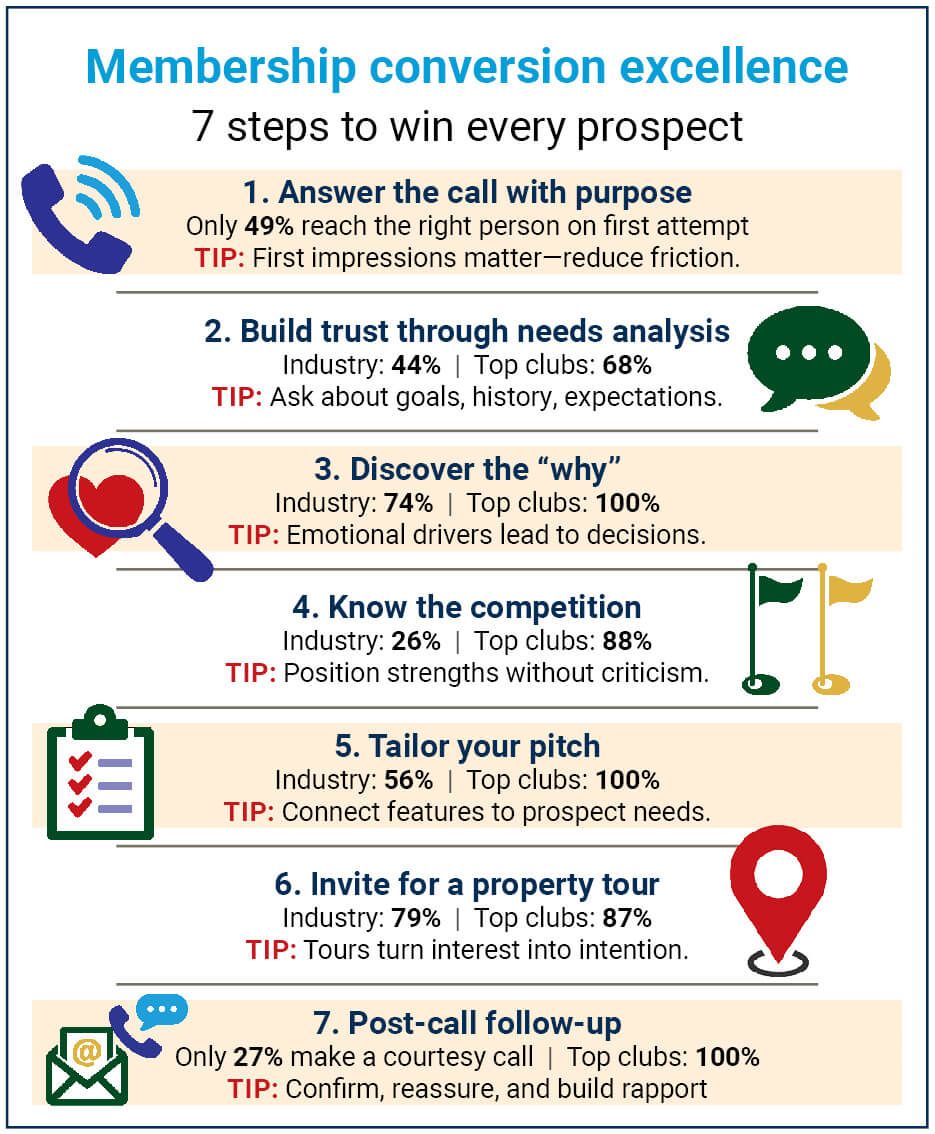
The industry-wide data tells a worrying story. Callers speak to the correct person on the first attempt only 49% of the time. That means every other prospect starts their experience with friction, and friction is the enemy of conversion.
Consider the psychology: Prospects are motivated. They might be frustrated with their current club, excited by a recent visit or acting on a friend’s recommendation. Momentum is on your side, until the call rings out or they are passed around departments like a misplaced parcel.
This is where a club’s processes, or lack thereof, speak volumes.
A missed call isn’t just a missed call, it’s a message: We weren’t ready for you. And in a competitive landscape, if the prospect calls a competitor who answers quickly, engages warmly and handles the inquiry confidently, you may never get a second chance.
Needs analysis: The human element that builds trust
Once the call connects, the goal is no longer just to answer questions; it’s to build a relationship.
The best membership professionals excel at this naturally. They ask about playing history, golfing background, ability, experience with other clubs, frequency of play and what they hope to gain from membership. These simple conversation starters are also incredibly powerful.
Yet industry-wide, clubs only capture this personal context 44% of the time. Top-performing clubs achieve 68%, giving them a deeper understanding of the prospect and a stronger foundation for guiding them to a decision.
Membership is not a transactional purchase; it’s emotional, aspirational and personal. People join clubs for belonging, status, community, routine or a place that feels like “theirs.”
Every piece of information gathered helps tailor the conversation to these deeper motivations, something no generic sales pitch can achieve.
Understanding the “why”: The secret to influencing the “yes”
Establishing a prospect’s primary reason for a membership and whether anything prompted the inquiry is equally as essential. Are they dissatisfied elsewhere? Did they relocate recently? Are they seeking competition, camaraderie or social connection?
Asking why a prospect is calling uncovers emotional drivers that lead to a decision. Each reason creates an opportunity to shine:
- New to the area → emphasize community and social integration.
- Need for client entertainment → stress prestige, hospitality and convenience.
- Seeking competitive golf → promote your leagues and tournament schedule.
- Unhappy with course conditions elsewhere → highlight your investment program.
Membership sales are not about lists of features, they’re about relevance. When clubs articulate value through the lens of a prospect’s personal motivations, the conversation moves from information to inspiration.
The industry asks these “why” questions 74% of the time. Podium clubs? 100%. That consistency builds trust early.
Competitor awareness: Playing smart, not hard
Despite its importance, only 26% of clubs ask whether the caller is considering other venues. Podium clubs hit 88%.
This question isn’t about criticism; it’s about positioning. Understanding the competitive landscape allows staff to speak confidently about your strengths, subtly guiding prospects toward choosing you, without downplaying others. Correctly executed, it can become the turning point in the conversation.
Tailored promotion: Turning insight into influence
With all information gathered, your team should be perfectly positioned to deliver a tailored overview of the club, one that connects each feature to a specific need the prospect expressed.
Yet the industry achieves this personalized promotion only 56% of the time. Top performers? Another 100%.
This gap represents one of the biggest lost opportunities in membership sales.
Generic promotion is noise. Tailored promotion is persuasion.
When prospects can picture themselves benefitting from the facilities, services and community, their interest deepens. They start to imagine life as a member, and that emotional shift is invaluable.
Property tour: Where interest becomes intention
Once a prospect is excited, the property tour is the next logical step. This is where the magic happens; you’re no longer telling them why membership is valuable, you’re showing them.
Podium clubs attempt to schedule a tour 87% of the time; the industry averages 79%.
Consistency in inviting prospects ensures more of them visit and experience the atmosphere, facilities and the member culture that can seal the deal.
The property tour is your story in motion; every facility, staff interaction and member they meet shapes the narrative.
Post-call excellence: Where great clubs win and others lose momentum
After arranging a property tour, many clubs assume the hard work is done. The post-call stage is one of the most influential parts of the sales journey. It is here where professionalism is confirmed or where momentum quietly falls away.
The first step is the confirmation email. This should thank the prospect for their inquiry and outline visit details: date, time, meeting point and a recap of what to expect. While this might seem basic, the best clubs maintain a 29% lead over the industry in delivering this consistently. This email reassures the prospect, demonstrates organization and keeps your club front of mind.
The second, often-overlooked step is the call to waterproof the appointment. This short, courtesy call checks receipt of the email to confirm attendance and ensures directions and expectations are clear. It also offers a moment to encourage the prospect to bring others: family, friends, playing partners or colleagues.
As we say, it’s better to sell to two than one.
Beyond logistics, this call builds rapport and trust, signaling attentiveness and care at a level that competitors rarely match. In fact, the simple act of picking up the phone often places your club ahead before the appointment even begins.
Despite its impact, only 27% of clubs make this call, while the best of the best do so 100% of the time.
This is where truly exceptional clubs separate themselves. In membership sales, success isn’t one moment; it comes from never missing a beat in the process.