

Technology is changing how golf courses operate, connect with customers and manage their businesses. And with artificial intelligence becoming an increasingly important part of the industry, the pace of that change is only accelerating.
In 2022, we asked technology leaders to predict how innovations would reshape the golf industry in the years ahead. Four years later, some of those developments are already taking hold, while new technologies are creating opportunities that were difficult to imagine just a few years ago.
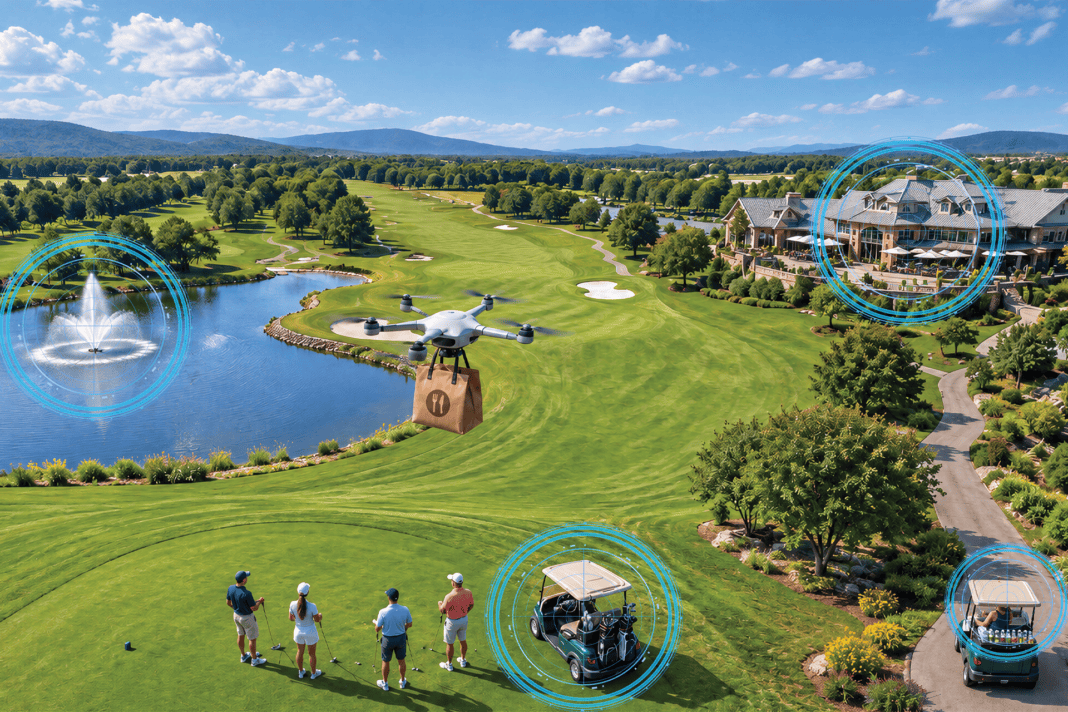
Consider Salgados Golf Club in Portugal, which recently announced an on-course drone delivery service that allows golfers to order food and beverages through an AI-powered concierge on WhatsApp. Orders are integrated into the club’s point-of-sale system, then prepared and delivered to golfers by drone. It’s one example of how emerging technologies are beginning to change both golf course operations and the customer experience.
Now, we’re looking toward 2030.
From AI-powered operations and automated tee time booking to personalized pricing, digital hospitality and customer engagement, technology is poised to influence nearly every aspect of golf course management. For owners and operators, the challenge will be determining which innovations deliver meaningful improvements to efficiency, profitability and the golfer experience.
B.K. Browne, co-founder and CEO of SpeakSport, believes one of the biggest opportunities lies in connecting the many systems golf facilities already use.
“Whether it’s the point of sale, a CRM, a weather tracking tool or whatever the technology might be, when AI is there that seamlessly connects every single layer to each other, that’s when everything comes together,” he said. “The data can truly be owned by the operator and understand to the fullest degree exactly what the guest is looking for and be able to serve them in every part of the golf experience.”
Mike Hendrix, founder and president of smbGOLF, expects digital hospitality to become an increasingly important consideration as operators recognize the value of their online presence and customer interactions.
“Operators are going to realize that the website is the one digital property that they actually own,” he said. “I don’t have complete control over how Google talks about me or how ChatGPT talks about me. But my website, I control it lock, stock and barrel. And more operators are going to realize that all these other platforms are reading their website so that they can develop their content about these businesses. So if you are super buttoned up on your website, it’s going to have a positive impact on your brand across all these platforms.”
For our 2030 technology forecast, we asked industry experts to examine where innovation is headed, what changes they expect over the next four years and how those developments could reshape golf course operations and the golfer experience. Here are their predictions.
Editor’s note: Some contributions were adapted from interviews and have been edited for length and clarity.
How AI will become the hub of golf course operations
By Scot Wellman, vice president of sales & marketing, Landscapes Golf Management
By 2030, I expect the biggest shift in golf technology to be where we do our work. Our preferred AI application could become the central workspace for running a golf operation.
Through our work at Landscapes Golf Management and Greenside Tech, I see tremendous opportunity to simplify how teams interact with technology. Today, employees move between tee sheets, point-of-sale systems, customer databases and reporting platforms. Tomorrow, many of those tasks could begin with a conversation.
A key enabler is Model Context Protocol, or MCP. MCP servers give compatible AI applications access to the data and actions that software providers make available. This creates a path for a large language model, or LLM, to become a common interface across multiple business systems.

Imagine telling your AI assistant: “Block the tee sheet next Thursday from noon to 2 p.m. for our charity outing.” With the necessary connections and permissions, it could check existing reservations, flag conflicts, request clarification and complete the change in your golf management system.
That same workspace could help coordinate an event, prepare customer communications, assign follow-up tasks and analyze results. The underlying software would continue managing records and transactions, while the AI application becomes the place employees direct the work.
This will change how we evaluate technology partners. Alongside features and service, operators should ask: Can your platform connect to our AI tools? What information and actions can we access? How are permissions, approvals and completed changes managed?
Connected data will also make those interactions more valuable. Teams could ask which outings generate the strongest total revenue or which members show declining engagement, then initiate an appropriate response.
Getting there will require reliable infrastructure, clean data and employee training. Adoption will depend on whether people trust the results.
My forecast for 2030 is a more unified operating experience, with AI connecting the tools behind the scenes and giving our teams more time to teach, host, sell and build relationships.
How AI-powered tee time booking will give operators more pricing power
By Jake Gordon, co-founder and CEO, Noteefy
By 2030, the most important pricing conversation at your course will happen between two pieces of software: the golfer’s AI agent and the operator’s tee sheet.
Over the past five years, dynamic pricing strategy taught operators what airlines, hotels and ticketing learned long ago: A tee time is a perishable product, and its rate should move with demand, weather, day of week and booking window. That lesson has shaped revenue management ever since. However, historical dynamic pricing technology and strategy changed how courses set the price, not where the sale happens.
Over the next few years, the biggest driver of rate will be access to exponentially more distribution via tee time booking agents.

Golfers are already starting to ask AI assistants to find and book tee times at accelerated rates. Across 200+ course websites we track, AI-referred visits grew 499% in 2025 while direct traffic fell. Agents go to the closest, easiest source of live inventory: the course’s own tee sheet. That means significantly more direct demand for operators. With little new supply coming online, more demand chasing a fixed number of tee times is a durable tailwind for rate. Agentic booking will drive more pricing power for course operators.
Individualized pricing won’t mean charging two golfers different prices for the same 8:10 tee time. It means agents hand operators something golf has never had at the moment of booking: explicit intent. A request like “this weekend, 8 to 10, under $100” carries budget, time window and flexibility. The course’s agent can answer with the right offer: a 7:50 with a cart for $95 or a premium package for the golfer shopping on experience.
For operators, three things change. The tee sheet becomes the storefront: If an agent can’t read, hold and book a time, you’re not on the shelf. Deposits and card-on-file separate real golfers’ agents from brokers’ bots. And revenue management becomes a daily, AI-assisted discipline instead of a seasonal rate card.
For golfers, booking gets simpler and regulars get recognized. The operators who are reachable, policy-protected and ready to compose the right offer will set the price. Everyone else will take it.
How AI will transform golfer interactions and course operations
Featuring B.K. Browne, co-founder and CEO, SpeakSport; and Mohit Motwani, co-founder and CTO, SpeakSport
Browne: We are the AI receptionist platform for the golf industry. We are owning the initial interaction with every single golfer at the property they’re looking to play, whether it’s a quick question by phone about the weather, or an upcoming event or tournament lead or simply a day-to-day booking. We are ensuring that we’re capturing the demand for every single operator while alleviating the simple fact of lines at the counter while the phones are constantly ringing, just to give the operator back that time for accelerated customer service and true face-to-face interaction on site, as opposed to putting calls on hold and running back and forth in the pro shop. Because the most important metric that we’re seeing in the golf industry is just the very first experience a golfer sees when on property or
engaging with the facility. If we can own that interaction and help the operator free up their time to allow them for face-to-face interaction, it opens up a plethora of amazing opportunities.

Motwani: AI is a critical part of unifying operations and keeping track to make things stay connected. I feel like any business, you have to make changes. And sometimes these changes or these experiments are not rooted in real data. But given that we are capturing every call, we know exactly what golfers are asking for, what they aren’t asking for, what time they’re looking to play, what they want to do. So the fact that operators get access to this data in one place is massive. They can actually figure out that, “Hey, if a lot of callers are calling from a specific zip code, maybe we should do something in terms of marketing there.” So that’s really the unlock.
Browne: Whether it’s a large-scale tournament or outing or just the initial outreach for a day-to-day tee time, applying AI across every interaction and every system is going to be the next lever for operations.
Motwani: It’s kind of like the web era where when it first came out, people were maybe a little bit slower to adopt it, but now it’s everywhere. Similarly, AI is going to ultimately be omnipresent. It’s going to be taking care of and assisting with every part of the workflow; it’s inevitable.

Browne: It’s not just AI for the golfer experience; it’s AI in the operator experience in every single department and every single individual who works with the property. They’ll each have their own individual AI agent that already knows them well and interacts with their given workflows on a day-to-day basis to help better performance and better customer service on property. That’s another lever that’s going to be continually refined over the coming years.
Why digital hospitality will become essential to golf operations
Featuring Mike Hendrix, founder and president, smbGOLF
By 2030, digital hospitality will become much more important as golf course operators recognize how their websites, online presence and other digital touchpoints influence the customer experience. That is to say, more operators are going to get to a place where they’re going to say, “Every digital touchpoint about my brand is now something that AI can have a great impact on.” It was much harder two years ago. It’s become much easier for them today. You’re going to see the majority of operators come to a realization of how much it impacts the bottom line. Digital hospitality will become more commonplace terminology in the industry. It will be something that the majority of operators want to be great at.
Loyalty will become a raging industry within lots of small businesses. You’re going to see much more sophisticated loyalty technology, and more small business operators are going to be able to pick what loyalty network they’re going to subscribe to. It will all be because the consumer experience, the golfer experience, can be much better across more sophisticated loyalty programs and platforms.

The economics have changed in golf. Now it makes a little more sense to invest. There’s real ROI now in selling tee times, whereas 10 years ago, it was a really challenging business just to scrape a little profit out of it. It only makes sense that as demand would grow, some of your better operators would realize, “Now would be the time to pour some money in and exponentially improve everything I’m doing,” which goes back and kind of can live under that umbrella of digital hospitality. So many guys now are saying, “If I up my game digitally, whether that’s through reservations or through loyalty or what have you, there’s probably more money to be made.” That’s only going to become a bigger deal.
And it’s not that even more people are going to be golfing three years from now than today — hopefully that is the case — but actually, as housing demands increase across the country, there are going to be fewer green grass facilities. It’s just a fact that there is no golf course operator in America that can say to a housing developer, “I’m going to make just as much money selling tee times as I would selling you this property for $35 million.” You’re going to see more shrinkage of the classic 18-hole green-grass facility, which will mean the people that do hang around, the golf courses that do remain, they’re going to make even more money three years from now than they make today. Because of that, you’re going to see even better and smarter investment into the tech and into the experience.
By 2030, digital hospitality will become a standard part of golf course management. Operators will increasingly be evaluated on the quality of their digital experiences, and those who fail to invest risk falling behind.
This article originally appeared in the November/December 2026 issue of Golf Inc.