

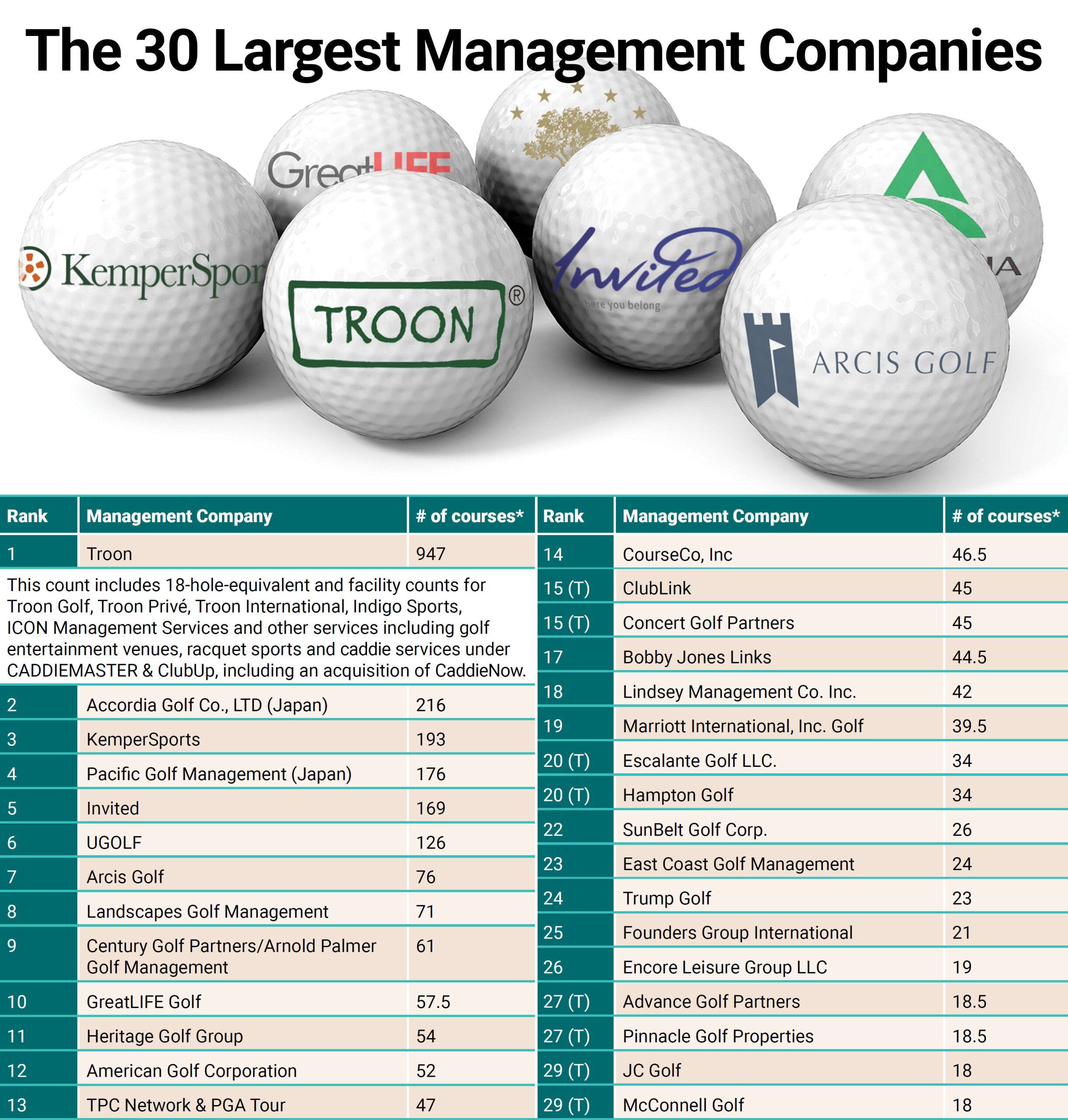
Golf’s largest management companies are growing — and getting more strategic about how they do it.
Troon, Arcis Golf, KemperSports, Landscapes Golf Management and others have expanded their portfolios in the past year through acquisitions, partnerships and new contracts. Many are offering tiered management models to serve a wider range of owners, from private equity groups to municipalities and HOAs.
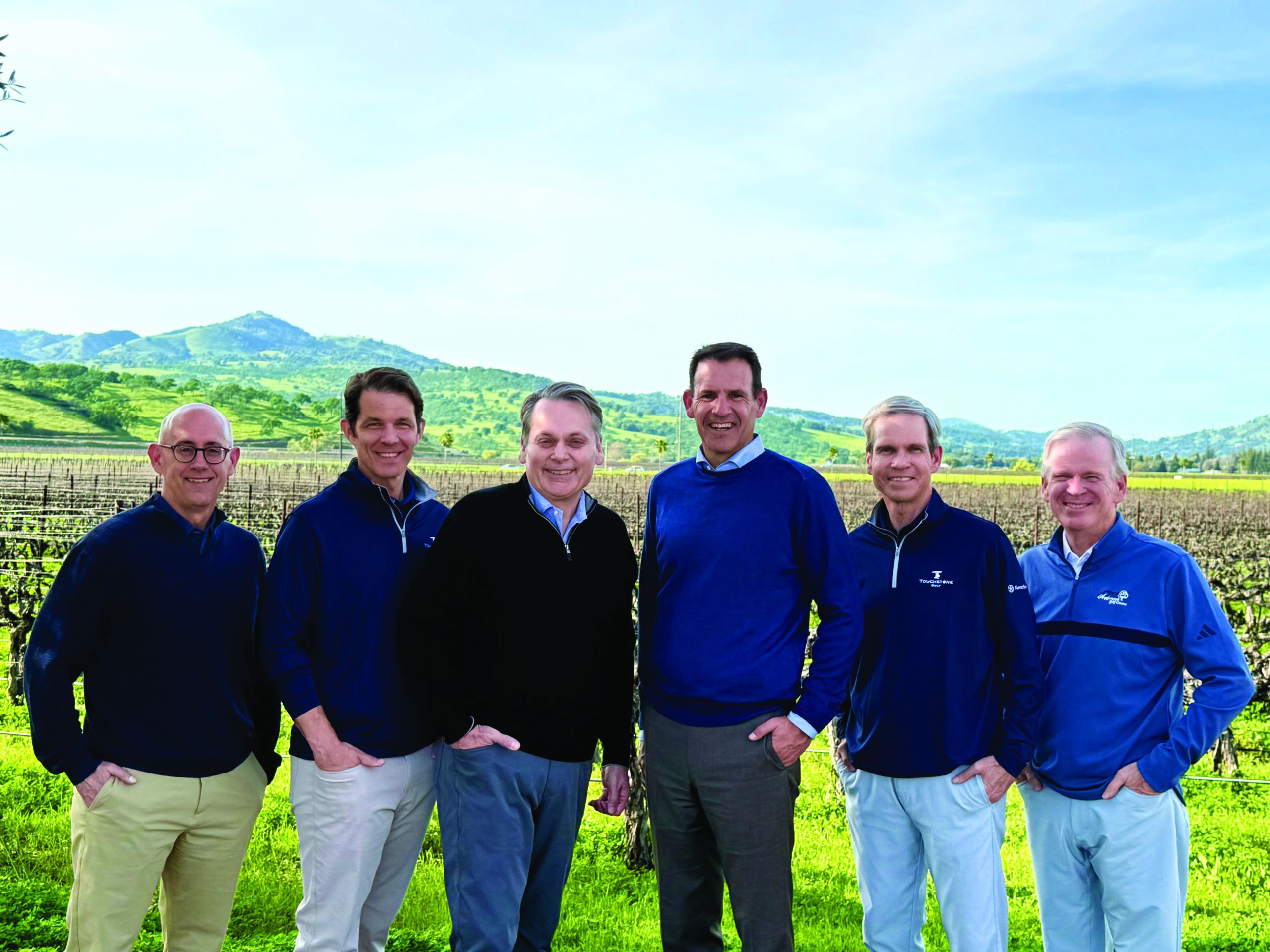
KemperSports added a major new division by partnering with Touchstone Golf and expanded its national presence with new courses in Missouri and New Jersey.
Landscapes Golf Management took on four new properties in 2025 and is working closely with HOAs and private owners to rebuild operations and improve course conditions.
Heritage Golf Group and Concert Golf Partners have stayed active on the acquisition front. Heritage added clubs in Tennessee, Colorado, North Carolina and Florida, while Concert expanded its private club portfolio with five new properties and invested in multi-million-dollar improvements at existing ones.
Together, these moves reflect a broader trend: Today’s leading operators are growing with a sharper focus on experience, efficiency and long-term strategy.
As portfolios expand, so does the focus on guest experience and lifestyle programming. Leading operators are leaning into service culture, member engagement and hospitality training across both private clubs and public courses.
Tech-driven amenities such as Toptracer bays, simulator lounges and mobile booking tools, are becoming more common.
Sustainability and course optimization are gaining ground. Agronomy and asset management teams are working more closely with owners to strike a balance between cost savings and quality of play.
Whether it’s acquisitions, partnerships or technology, the leading operators are taking a full-circle approach to growth.
Arcis Golf’s growth, strategy and what comes next
Arcis Golf’s past decade has been marked by aggressive growth, strategic diversification and a shift toward family-focused, lifestyle-driven club experiences. Since its founding, the Dallas-based company has become one of the largest owner-operators in the U.S. and now oversees 70 clubs across major metropolitan markets.
“It’s been a bit surreal to found as a start-up and see where we’re at today,” said Blake Walker, founder, chairman and CEO of Arcis Golf. “I’m blown away the most at the people that have joined Arcis along the way and the leaders in this organization.”
Much of the company’s expansion has come through a series of high-profile acquisitions.
“It’s been a series of big transactions,” Walker said.
Many of those acquisitions have centered around top-tier facilities in urban markets.
Since 2020, Arcis has acquired 15 clubs, including marquee names like The Woodlands Country Club in Texas, Grayhawk in Arizona and Champions Retreat near Augusta. The company also inked a new partnership with the LPGA, giving athletes access to Arcis facilities nationwide.
But the strategy isn’t just about growth for growth’s sake.
“Our thesis is really family-centric,” he said. “We’re really attempting to use golf as a flywheel.”
That focus has led Arcis to invest in health and wellness, events, fitness and subscription-based access, alongside its core golf operations.
Recently the company announced a partnership with iFIT Inc. to develop golf-focused fitness programming across iFIT’s network of more than six million users. The content will be produced at Arcis clubs using Freemotion equipment and integrated into iFIT’s mobile and machine-based platforms.
“This global partnership aligns perfectly with the health-and-wellness goals that are so important to our membership,” Walker said. “The collaboration with iFIT will expand our brand awareness to new audiences as we lead in golf fitness, best-in-class instruction and technology.”
At the core of Arcis’ strategy is what Walker refers to as the company’s four pillars: culture, experience, innovation and service. This is a framework that still guides day-to-day decisions and long-term planning.
Walker said the company continues to operate across traditional revenue streams while thinking more broadly about family engagement.
Troon’s scale, specialization and what’s next
In the past five years, Troon has expanded well beyond its roots in golf management. With nearly 950 18-hole equivalents at 1,110 facilities, the company now operates multiple verticals from racquet sports and hospitality consulting to caddie services and HOA management.
CEO Tim Schantz said the expansion has only added to the company’s core and grown its adjacencies.
“We’ve grown the caddie business significantly, added technology to the caddie business and grown the footprint for the managed side,” Schantz said. “We’ve grown the racquet sports business.”
Those newer verticals, like racquet sports and food & beverage consulting, function as standalone businesses but also support the company’s golf operations.
Troon also launched an events division focused on golf-related and other experiences, and its ICON HOA management division has grown significantly.
“That’s a service that we bring to bear, and that we’ve grown in the past five years,” Schantz said. “Somebody that was dealing with Troon five years ago now has even more capability to draw upon than they did in the past.”
Schantz said that even as the company has grown, its model remains grounded in hospitality — not size.
“We like to think of ourselves as a hospitality management company that is keenly focused on golf and golf-related hospitality,” he said.
He said scale gives Troon an edge, despite perceptions to the contrary.

“Sometimes our competitors use the size of the company against us,” he said. “I actually think it’s an advantage. The executives inside the company are really kind of running smaller companies of locations that they’re involved with, but they’re able to tap into a larger company to do so.”
Nowhere is that more visible than in Troon’s private club portfolio, which includes nearly 70 member-owned clubs.
“That’s a very high-touch business,” Schantz said. “Those clubs aren’t managed — the on-site people run those locations. But they are able to lean into a fully developed platform.”
Across the company’s daily-fee, resort and private segments, Schantz said most markets remain strong, even amid broader economic uncertainty.
“We’re just focused on doing our job, keeping our head down and growing the company in the places where it makes sense to grow,” he said.
One area of internal investment is digital. Troon’s Access program and mobile app are designed to enhance the guest experience and improve operations at public and resort properties.
Asked about Troon’s long-term vision, Schantz said it’s not about hitting a specific number.
“Success at Troon is continuing to be healthy and growing,” he said. “Having our clients feel like we’re providing good value and good services. Providing great opportunity for all of the associates.”
He also noted the staying power of Troon’s original strength.
“Troon starts at Troon North and is very well known for its agronomic excellence, which continues at the core of our competencies,” he said.
But one area of growth surprised him: F&B. There was demand for that service in a way that was different than he anticipated.
That, in some ways, reflects how Troon’s model has evolved — and how operators are thinking differently.
“I think we’re a good solution for clients that are out there looking to solve a problem,” Schantz said. “That’s kind of where we start.”
(This story originally ran in the July/August 2025 issue of Golf Inc.)